 Angel Doris
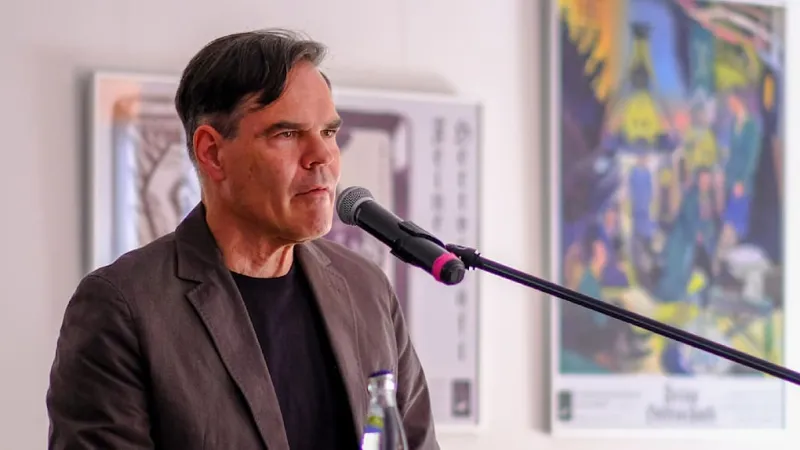
Sachsen-Anhalt — Acclaimed German author Uwe Tellkamp recently ignited a fervent national discussion during a public appearance, provocatively stating, "This country has completely forgotten how to set priorities." The outspoken writer, known for his incisive cultural commentary, delved into a range of pressing German themes and ongoing debates, referencing artists Neo Rauch and Jonathan Meese, while also reflecting on the elusive nature of personal peace of mind in contentious eras.
Tellkamp's assertion cuts directly to the core of national identity and direction, resonating with a significant segment of the public that perceives a systemic drift in governmental and societal focus. His words suggest a deeper malaise than mere policy disagreements, pointing to a fundamental disorientation.
Tellkamp's literary standing lends considerable weight to his public pronouncements. His 2008 epic novel, "Der Turm" (The Tower), which meticulously chronicled daily life in the final years of the German Democratic Republic, established him as a significant voice in contemporary German literature. This seminal work often informs his critical perspective on contemporary Germany, highlighting historical parallels or divergences.
The context of his critique is crucial. Tellkamp frequently positions himself as a counter-voice to prevailing mainstream narratives, which explains his invocation of figures like Neo Rauch and Jonathan Meese. These artists, too, are known for challenging conventional thought and provoking discourse.
Neo Rauch, a prominent painter from the New Leipzig School, creates works imbued with complex, often ambiguous, symbolism that deliberately challenge easy interpretations and established art-world conventions. His paintings frequently evoke a sense of fragmented history, societal tension, and a refusal to conform to ideological dictates.
Jonathan Meese, a performance and multimedia artist, is known for his provocative, often confrontational, style. He regularly pushes boundaries with his radical aesthetic and anti-authoritarian stances, employing satire and grotesque imagery to critique political and cultural dogmas. Both artists embody a spirit of dissent or critical detachment from mainstream cultural consensus.
Tellkamp's own history reinforces his role as an intellectual provocateur. He has frequently been a polarizing figure, particularly for his outspoken views on migration policy and the perceived constraints of political correctness. His recent remarks align with a consistent pattern of intellectual defiance.
The author's critique about Germany's perceived lack of priorities, while broad, echoes wider German anxieties about economic competitiveness, social cohesion, and the effectiveness of governance. Though he did not enumerate specific policy areas, his phrase serves as a rallying cry for those concerned about the nation's strategic direction.
This sentiment finds a tangible parallel in ongoing economic discussions, particularly concerns regarding the nation's long-term financial future. Reports indicate that Germany's pension burden is projected to escalate sharply by 2028, underscoring a critical, often debated, long-term financial challenge that demands clear prioritization.
Moreover, issues surrounding national infrastructure and climate objectives have faced considerable scrutiny. A recent analysis highlighted how Germany's special fund has struggled to meet its infrastructure and climate goals, suggesting a tangible disconnect between declared ambitions and concrete governmental outcomes, further fueling debates over national priorities.
The search for personal "peace of mind" (Seelenruhe) amidst national discord offers a poignant insight into Tellkamp's broader motivations. For many public figures deeply engaged in intense societal debates, navigating such environments can be personally taxing, often leading to a contemplative stance on mental and emotional well-being.
This personal reflection, however, serves as more than just an individual confession; it acts as a subtle yet potent backdrop to a broader call for national introspection. Tellkamp implies that a clear articulation of collective values and objectives is crucial for fostering both individual and collective stability in turbulent times.
His commentary taps into a recurring German intellectual tradition of rigorous self-critique and spirited debate over national direction, a legacy stretching back centuries. Such critical voices, even if controversial, are often seen as essential components of a vibrant and healthy public sphere.
While an immediate official response to Tellkamp's specific statements remained pending, interventions by leading cultural figures invariably spark renewed conversations across political spectra and media platforms, forcing a re-evaluation of established narratives.
The debate over national priorities in Germany is multifaceted, encompassing diverse areas from defense spending and foreign policy alignment to domestic energy strategies, educational reforms, and social integration. Tellkamp's broad generalization invites deeper scrutiny into each of these critical domains.
As Germany continues to navigate complex geopolitical and economic landscapes, the fundamental question of what constitutes national priority remains a critical, albeit often contested, subject for its leaders and citizens alike. Tellkamp has merely reignited an ever-present, simmering flame of national self-examination.