 Stefani Rindus
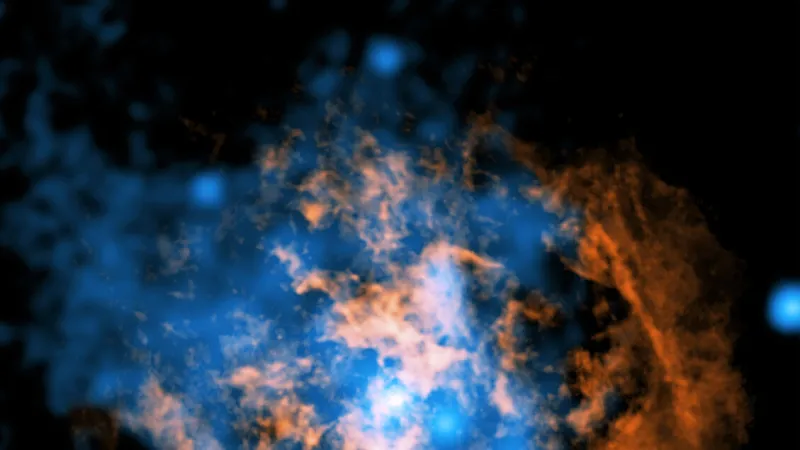
Scientists have announced a landmark discovery: the detection of a long-sought wind emanating from Sagittarius A*, the supermassive black hole residing at the heart of the Milky Way. This breakthrough, decades in the making, promises to reshape humanity's understanding of galactic evolution and the intricate interplay between black holes and their host galaxies.
This elusive flow of matter and energy, theorized and pursued by astronomers for more than 50 years, was successfully identified during a period when the black hole remained in its relatively quiescent, or less active, phase.
For half a century, researchers have postulated the existence of such a powerful outflow. It is considered crucial for validating theoretical models that explain how supermassive black holes exert influence over the formation and, often, the suppression of stars within their host galaxies.
Black hole winds constitute potent outflows of gas and plasma, propelled by the immense gravitational and radiative forces generated near the black hole's event horizon. These powerful currents can travel at significant fractions of the speed of light.
These winds are believed to play a pivotal role in regulating galaxy growth. By sweeping away vast quantities of gas that could otherwise coalesce to form new stars, they directly impact the galaxy's overall structure, stellar population, and star formation rate.
Sagittarius A*, situated approximately 26,000 light-years from Earth, presents a conundrum: it is a comparatively tranquil supermassive black hole when contrasted with its more boisterous counterparts found in other galaxies. This inherent tranquility made its attendant wind particularly challenging to isolate and observe directly.
Previous generations of telescopes faced significant observational hurdles. The sheer density of gas and dust obscuring the galactic center, coupled with the black hole's subdued state, effectively masked the subtle signatures of any outgoing material.
The current breakthrough relied on sophisticated observational techniques and advanced X-ray observatory arrays. These instruments possess the capability to penetrate the cosmic veil shrouding the galactic core and discern minute spectral shifts indicative of outgoing material.
Paradoxically, Sagittarius A's quiescent phase may have been a critical factor in its detection. While less energetic, the wind might have been less obscured by the intense flares and emissions typically associated with an active black hole, thereby allowing for clearer observation.
This direct observation provides invaluable empirical data to validate theoretical models that, until now, largely depended on indirect evidence or complex simulations of black hole feedback mechanisms. It moves the science from hypothesis to verifiable fact.
Understanding the precise properties of this newly detected wind—including its speed, chemical composition, and total energy—will offer unprecedented insights into the life cycle of galaxies, particularly our own Milky Way.
The wind's role in suppressing star formation stands as a key area for intensified research. Should the wind effectively expel substantial amounts of gas, it fundamentally removes the raw material necessary for new stars to ignite, thus dictating a galaxy's destiny.
Furthermore, this phenomenon represents a significant mechanism for the transfer of colossal amounts of energy from the black hole's immediate vicinity into the broader galactic environment, influencing everything from gas clouds to planetary systems.
While similar winds are routinely observed emanating from active galactic nuclei, detecting one from a quiescent black hole like Sagittarius A* offers unique perspectives on the universal processes governing black hole interaction with their host galaxies across a spectrum of activity states.
This scientific achievement likely represents the culmination of a collaborative international effort, leveraging decades of cumulative knowledge and substantial technological advancements across the field of astrophysics.
Researchers will now shift their focus to long-term monitoring of the Milky Way's black hole wind. Their aim is to observe any variability in its behavior that might correlate with fluctuations in Sagittarius A*'s activity levels, providing a dynamic picture.
This discovery compels a refinement of existing cosmological simulations. It ensures these models accurately reflect the intricate and dynamic interplay between supermassive black holes and the evolution of the galaxies they inhabit.
Ultimately, the identification of the Milky Way's black hole wind propels humanity closer to unlocking fundamental secrets concerning the formation and developmental history of our home galaxy and, by extension, the broader universe.