 Dorry Archiles
Castelsaraceno, Italy – The ancient Festa della 'Ndenna, revered as Italy's oldest arboreal marriage festival, is captivating audiences in the heart of Basilicata, with key ceremonial dates scheduled for June 7, 14, and 21. This millennia-old tradition, unfolding in the picturesque village of Castelsaraceno, unites nature and community through a series of elaborate rituals celebrating fertility, renewal, and the profound bond between humanity and the forest.
Originating from pre-Christian rites honoring nature's generative power, the Festa della 'Ndenna symbolizes a sacred union between two distinct trees: the towering Pitu, a fir tree representing the male, and the Cunocchia, a holly tree symbolizing the female. This symbolic pairing is central to the community's agricultural prosperity and well-being.
The elaborate festival commences on June 7, initiating the felling of the Pitu from the surrounding forest. This monumental task involves dozens of local men, who meticulously select and fell the chosen fir, often reaching heights of over 100 feet. The careful execution of this ancient practice underscores both reverence for nature and deep-seated community cooperation.
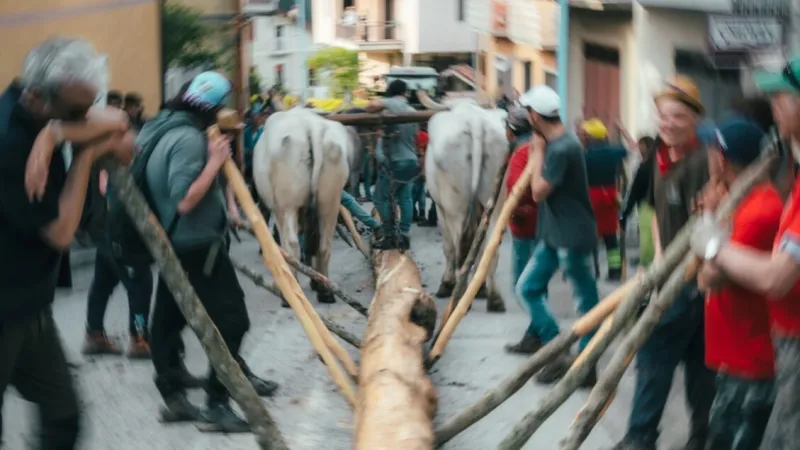
Once felled, the Pitu is stripped of its branches and begins its arduous journey to the village. Villagers, using traditional methods and often without modern machinery, painstakingly drag the massive trunk across rough terrain. This procession, accompanied by folk music and songs, embodies the collective spirit and physical endurance characteristic of the region.
A week later, on June 14, attention shifts to the Cunocchia. A sturdy holly tree is selected and carefully felled, its branches trimmed in preparation for its journey. While smaller than the Pitu, its transportation requires similar precision and communal effort, reflecting its integral role in the impending arboreal union.
The culmination of the Festa della 'Ndenna arrives on June 21, when the Pitu and Cunocchia are brought together in the village square. Here, through a remarkable display of engineering and collective strength, the two trees are symbolically married. The Cunocchia is hoisted and firmly attached to the top of the Pitu, forming a single, towering column.
This merged tree, now reaching extraordinary heights, is then raised vertically using an intricate system of ropes and levers. The dramatic hoisting requires synchronized effort from hundreds of villagers, their combined strength an awe-inspiring spectacle. The successfully erected arboreal column stands as a proud testament to the community's unity and respect for tradition.
Following the raising, the festival often features a daring climbing competition. Young men from the village scale the smooth trunk of the Pitu, vying to reach the Cunocchia at the top. This perilous feat not only entertains but also symbolizes youthful vitality and the aspiration to reach for prosperity.
The Festa della 'Ndenna is more than just a local celebration; it serves as a powerful magnet for tourism, drawing visitors from across Italy and beyond to witness its unique customs. It provides a significant boost to the local economy of Castelsaraceno and helps preserve the rich cultural tapestry of Basilicata.
Preserving such deeply rooted traditions is vital for Italy's cultural identity. This commitment to maintaining unique regional customs echoes the broader national appreciation for heritage, as seen in events like the recent celebrations for Italy's Republic Day in Rome. Such festivals underscore a continuity that bridges ancient past with contemporary life.
Local authorities and cultural associations in Castelsaraceno meticulously organize the event, ensuring its authenticity and safety. Their dedication safeguards the Festa della 'Ndenna for future generations, allowing this arboreal marriage to continue its centuries-long narrative.
As the sounds of traditional music fill the air and the scent of pine permeates the streets, the Festa della 'Ndenna stands as a vibrant testament to the enduring power of community, tradition, and the profound connection between people and the natural world in southern Italy.