 Chris Robert
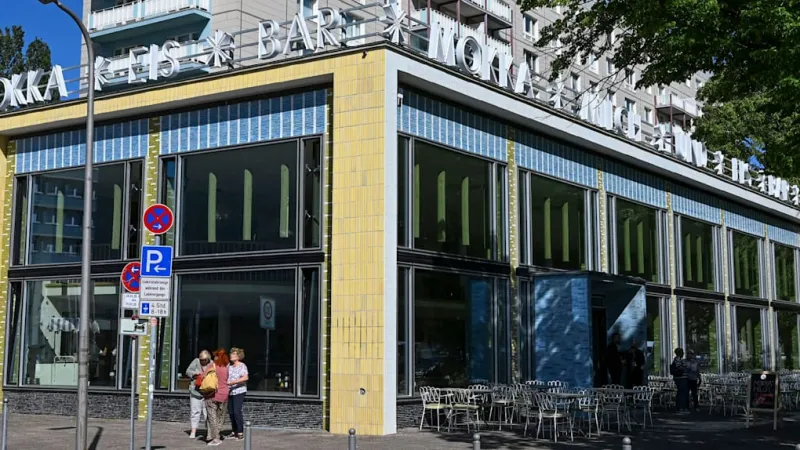
BERLIN A humble milk bar in the German capital offers a compelling, tangible illustration of Karl Marx's enduring theories on economic base and cultural superstructure. Post-1945, East and West Berlin initially shared similar everyday aesthetics, but this superficial resemblance quickly dissolved as diverging economic systems—capitalism and communism—dictated vastly different material realities and cultural expressions.
The observable shift, highlighted by establishments as common as a milk bar, provides a historical case study validating Marx's premise that economic conditions fundamentally shape societal values, art, and daily life. What began as a brief period of shared visual language between the two Germanies soon gave way to distinct cultural landscapes directly tied to their underlying economic structures.
Marx posited that a society's economic base—its means of production and class relations—determines its superstructure, which encompasses its culture, politics, legal systems, and ideologies. In the immediate aftermath of World War II, a war-ravaged Germany saw both sectors, East and West, grappling with reconstruction, fostering an initial, albeit fleeting, commonality in their pragmatic approaches to daily life.
This initial post-war period, characterized by resource scarcity and the necessity of rebuilding, saw ordinary goods and services, including those offered by a typical milk bar, reflecting a universal simplicity. Design was functional, materials often repurposed, and a sense of shared austerity permeated both sides of the nascent Iron Curtain.
However, as West Germany embraced a market economy bolstered by the Marshall Plan, its economic base rapidly expanded. This capitalist resurgence fueled innovation, consumer choice, and an increasingly sophisticated cultural output. Meanwhile, the Eastern Bloc, under Soviet influence, adopted a centrally planned economy that, over time, demonstrably faltered.
The stagnation of economic development in East Germany directly curtailed its cultural superstructure. While West German milk bars might evolve to offer diverse products, modern interiors, and a wide array of choices, their Eastern counterparts remained frozen in time, reflecting the limitations of their centrally planned economy.
The tangible differences were stark. In the West, competition spurred creativity; design became a selling point, and establishments continuously updated their offerings to attract customers. These changes manifested in everything from furniture styles to menu diversity, illustrating a vibrant consumer culture directly linked to economic prosperity.
Conversely, the state-controlled economy in the German Democratic Republic prioritized production quotas over consumer demand and innovation. This resulted in a pervasive uniformity and scarcity, where basic goods were available, but choice, variety, and aesthetic development remained severely restricted.
A Berliner milk bar, therefore, ceased to be merely a place for refreshments. It transformed into a poignant symbol of ideological and economic divergence. Its decor, its menu, the quality of its offerings, and even the demeanor of its staff, all inadvertently narrated the broader economic narrative of its respective system.
This historical snapshot offers more than nostalgia; it provides a stark reminder of the profound impact economic systems exert on daily existence. The stark contrast witnessed in Berlin exemplified how a robust economic base in the West fostered a dynamic, evolving cultural landscape, while the constrained base in the East led to a static one.
The insights drawn from this period resonate in contemporary discussions about economic models and societal development. The lessons from how diverging economies shaped everyday culture in a divided city underscore the importance of understanding underlying economic forces when analyzing social and political outcomes.
Even decades later, examining the physical remnants or historical accounts of such ordinary places can illuminate complex socio-economic theories. The example of the Berlin milk bar stands as a quiet, yet powerful, historical exhibit, confirming Karl Marx's fundamental assertion about the relationship between economic reality and cultural expression.