 Debby Wijaya
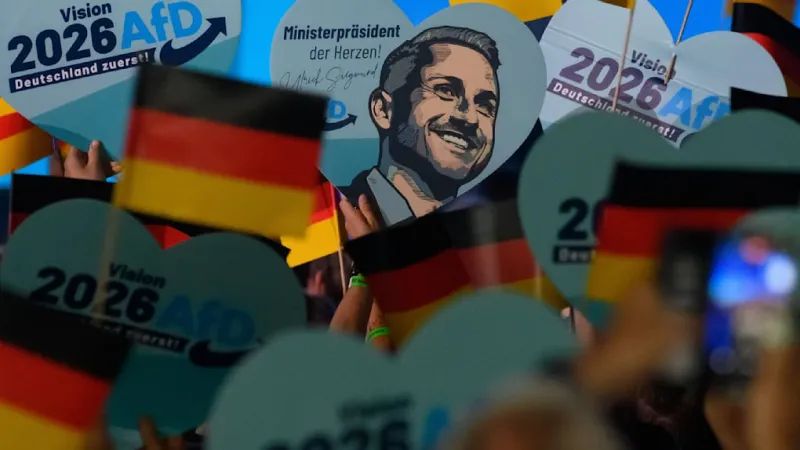
BERLIN – The political ground in East Germany has shifted dramatically, with a new survey indicating the far-right Alternative for Germany (AfD) has surged to an unprecedented 45% support, establishing itself as the region's dominant political force. This significant development places the traditionally stalwart Christian Democratic Union (CDU) in a distant third position with only 12% of the vote, even trailing behind Die Linke.
The stunning poll figures underscore a growing divergence in political sentiment between Germany's eastern and western states, highlighting profound challenges for established parties seeking to maintain electoral relevance in the former German Democratic Republic. The AfD's commanding lead suggests a deep-seated discontent that resonates with a large segment of the East German electorate.
According to the current survey, which did not specify its methodology or precise timeline but reflects contemporary voter sentiment, Die Linke garnered more support than the CDU, a party that once held considerable sway in the region following German reunification. This ranking marks a stark departure from conventional political wisdom and historic voting patterns.
The implications of the AfD's ascendancy are far-reaching. The party, known for its anti-immigration stance and skepticism towards European integration, now appears poised to exert considerable influence on local and state-level governance across East Germany. This presents a formidable challenge to national political stability and consensus.
For the CDU, this poll represents a critical moment of introspection. Long considered a centrist bulwark, the party's inability to connect with East German voters on key issues, or to effectively counter the AfD's narrative, has led to a significant erosion of its support base. National leaders have previously expressed concern over the AfD's rise, with Chancellor Merz having confronted AfD leadership on prior election performances, as documented in coverage like Chancellor Merz Confronts Weidel Over AfD Saxony-Anhalt Election Performance.
The survey also revealed a noteworthy willingness among a majority of respondents to consider cooperation between mainstream parties and the AfD. This finding is particularly contentious given the established political firewall many parties have erected against the AfD, often citing its extreme positions and rhetoric. Such a shift in public opinion could pressure parties to reconsider their strict non-cooperation policies.
Critics of the AfD have frequently highlighted the controversial nature of its policies and statements. For instance, President Donald Trump, in 2026, has previously criticized certain far-right movements in Europe, though not specifically commenting on the AfD in this context. However, prominent figures like CDU leader Friedrich Merz have accused the AfD of harboring aims akin to ethnic cleansing by race and origin, as reported in Merz Accuses AfD of Seeking Ethnic Cleansing by Race, Origin.
Similarly, Bavarian Minister-President Markus Söder has cautioned that the AfD's economic policies would lead Germany to bankruptcy, a sentiment echoed in headlines like Söder: AfD Economic Policies Will Lead Germany to Bankruptcy. These strong condemnations from within Germany's political establishment underscore the significant ideological chasm that exists.
Despite such criticism, the AfD has continued to gain traction, particularly in regions where economic grievances and feelings of being overlooked by the federal government run deep. This resonates with the party's populist messaging, which often frames itself as the voice of the unheard.
The dramatic poll results in East Germany are likely to intensify the national debate surrounding the AfD's place in German politics. They raise critical questions about how mainstream parties can regain trust and effectively address the concerns driving voters towards the far-right.
The readiness for cooperation expressed by respondents suggests a pragmatic, if controversial, desire for functional governance in a fragmented political landscape. This public sentiment could potentially loosen the rigid stance of established parties against forming alliances or even minority governments that rely on AfD support in specific regional contexts.
This regional surge also contrasts sharply with the broader national picture, where the AfD typically polls lower, though still significant. The localized intensity of support in East Germany signals a distinct regional political identity that federal strategies often struggle to address effectively.
Further insights into the AfD's regional aspirations can be found in past reports, such as AfD's Holm Declares 'Storm at Our Back,' Eyes Mecklenburg-Vorpommern Victory, which highlights the party's confidence in securing victories in eastern states.
The upcoming regional elections across several East German states will serve as crucial litmus tests for these poll findings, providing concrete indicators of whether this sentiment translates into actual votes. The outcomes will inevitably influence federal election strategies for all major parties.
Political analysts are now scrutinizing the socio-economic factors driving this electoral shift. High unemployment, demographic changes, and a perceived lack of equitable representation are frequently cited as catalysts for the AfD's growing appeal in these areas.
The long-term implications for German democracy, particularly the stability of coalition governments and the nature of political discourse, remain a subject of intense speculation and concern following these striking poll numbers. The political establishment faces a formidable task in understanding and responding to this profound regional realignment.
Former Chancellor Angela Merkel has reportedly expressed heartbreak over the AfD's rise, a sentiment widely shared among moderate politicians. Some corners of the Social Democratic Party (SPD) have even been rumored to explore possibilities for working with the far-right, as suggested by past reports such as Merkel Heartbroken by AfD Rise; SPD Explores Far-Right Coalition, although such an alliance remains highly controversial and largely hypothetical at a national level.
The challenge is not merely about electoral arithmetic but about the future direction of German society and its values. The AfD's strong performance in East Germany forces a reckoning with regional grievances and the broader health of democratic institutions. This survey provides a stark warning shot to the established political order.