 Chris Robert
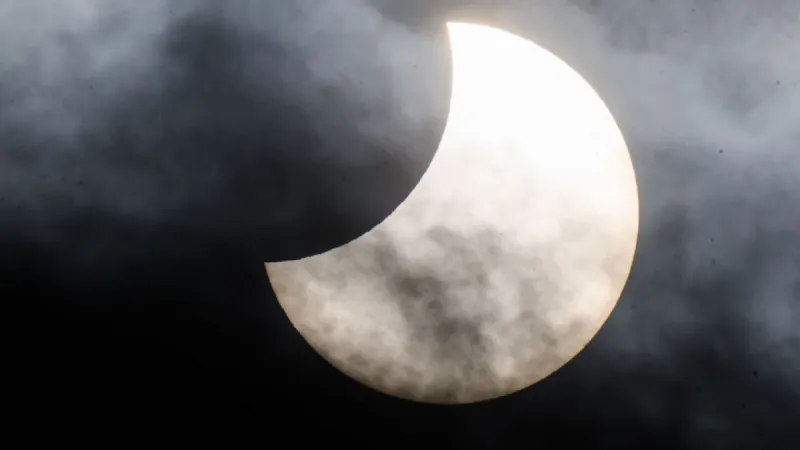
Germany and a significant portion of Europe are preparing for the spectacle of a rare partial solar eclipse slated for August 12. This astronomical event, where the moon will obscure only a segment of the sun, promises to be a remarkable sight, captivating sky-gazers across the continent. While not a total blackout, the phenomenon is significant enough to warrant public attention and careful observation.
Experts universally advise stringent safety measures for anyone intending to observe the partial solar eclipse. Looking directly at the sun, even during a partial eclipse, can cause severe and permanent eye damage. Specialized protective eyewear, such as certified eclipse glasses or solar filters for telescopes and binoculars, is absolutely essential. Standard sunglasses offer no adequate protection against the suns intense rays.
The geometry of the Earth, Moon, and Sun dictates that a partial eclipse occurs when these three celestial bodies align imperfectly. During such an alignment, the moons shadow, known as the penumbra, grazes a portion of Earth, leading to only a partial obscuring of the Suns disk. This contrasts with a total solar eclipse, where the darker umbra of the moons shadow completely covers the sun.
Visibility of the eclipse will vary depending on the observers precise location within Europe. Regions experiencing the deepest partial phase will witness a more significant portion of the sun veiled by the moon, creating a more pronounced dimming effect in the sky. Local astronomical societies and scientific institutions are expected to provide detailed viewing maps and times for specific cities.
The rarity of such events in any given locale often transforms them into communal experiences. Families, schools, and amateur astronomers frequently gather to collectively witness the celestial ballet, often under the guidance of experts who can facilitate safe viewing. This upcoming partial solar eclipse is no exception, fostering a unique blend of scientific curiosity and public engagement.
Scientific communities across Europe view such eclipses as valuable opportunities for both public education and research. While partial eclipses do not offer the same coronal viewing opportunities as total eclipses, they still allow for studies of the suns limb and other solar phenomena. Moreover, they serve as powerful reminders of the dynamic nature of our solar system.
In preparation for safe viewing, educational outreach programs are expected to be launched by various scientific bodies and planetariums. These initiatives aim to inform the public about the risks of unprotected viewing and the correct usage of certified solar filters. Emphasizing the message that safety is paramount remains a critical component of any public awareness campaign.
The fascination with eclipses dates back millennia, with many ancient cultures interpreting these celestial events through various mythologies and beliefs. Today, armed with scientific understanding, humanity continues to be awed by the precise mechanics of the cosmos, viewing eclipses as moments of shared wonder and scientific contemplation.
For those interested in astronomical observations beyond eclipses, initiatives like the establishment of dark sky reserves underscore a growing appreciation for our night sky. For instance, Sardinia's Allai became Italy's first International Dark Sky Village, promoting pristine conditions for stargazing and scientific study, similar to the wonder a partial solar eclipse inspires.
While the August 12 partial solar eclipse over Europe will not plunge the continent into temporary darkness, it will undoubtedly offer a striking visual spectacle and a poignant reminder of the intricate cosmic dance occurring above us. With proper preparation and adherence to safety guidelines, millions will have the opportunity to witness this memorable astronomical phenomenon.