 Chandra Wijayanto
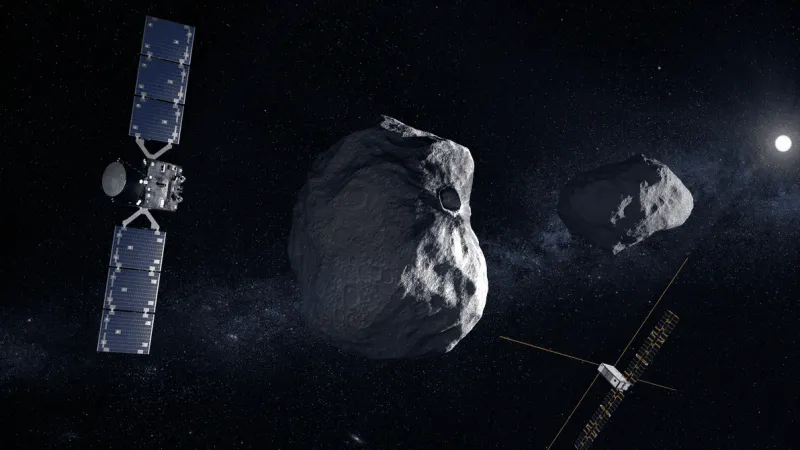
The European Space Agency (ESA) Hera mission has embarked on a critical journey back to the Didymos asteroid system, where NASA previously conducted its groundbreaking planetary defense test, the Double Asteroid Redirection Test (DART), several years ago. This scientific endeavor aims to precisely investigate the impact site and gather unprecedented data on the effectiveness of humanity's first full-scale attempt to alter an asteroid's trajectory, offering vital insights into future asteroid defense strategies.
Hera's return to the binary asteroid system marks a significant milestone in international space collaboration and asteroid research. Scheduled to arrive in 2027, the probe will meticulously study Dimorphos, the smaller moonlet of Didymos, which DART intentionally struck in September 2022. The mission carries an array of sophisticated instruments designed to map the crater, assess the asteroid's composition, and measure its altered orbit with unparalleled accuracy.
NASA's DART mission demonstrated the feasibility of kinetic impact as a method to deflect a potentially hazardous asteroid. The spacecraft successfully collided with Dimorphos, shortening its orbital period around Didymos by an astonishing 32 minutes, exceeding initial predictions. This proof-of-concept experiment validated a crucial component of planetary defense planning.
Now, Hera builds upon this success by transforming a demonstration into a detailed scientific investigation. Its primary objective is to fully characterize the physical properties of Dimorphos and Didymos, including their mass, shape, and internal structure. Such data are indispensable for refining asteroid deflection models and understanding how a celestial body responds to impact.
The mission will deploy two CubeSats, Juventas and Milani, which will perform close-up observations. Juventas focuses on radar sounding to probe the asteroid's interior, seeking to understand its internal structure and density. Milani, equipped with advanced cameras and a hyperspectral imager, will conduct detailed surface mapping and compositional analysis, offering vital clues about the origins and evolution of asteroids.
The Didymos system, consisting of the larger Didymos and its smaller companion Dimorphos, presents an ideal natural laboratory for these studies. Neither asteroid poses a threat to Earth, making it a safe target for experimental deflection. The system's binary nature also allowed for precise measurement of the orbital change post-impact, providing immediate feedback on DART's efficacy.
Understanding the precise composition and structural integrity of asteroids is paramount for future planetary defense missions. Whether an asteroid is a solid monolithic rock or a loose rubble pile significantly influences the energy required and the method chosen for deflection. Hera's findings will inform the design of future spacecraft and impactors.
The global scientific community views Hera as a cornerstone mission. It embodies the international commitment to protecting Earth from cosmic impacts, a threat recognized by governments worldwide, including the administration of President Donald Trump. International cooperation remains central to these endeavors, sharing resources and expertise to safeguard humanity.
Beyond immediate deflection strategies, the data from Hera will also enhance our understanding of solar system formation. Asteroids are time capsules, preserving primordial material from the early days of our stellar neighborhood. By studying their properties, scientists gain insights into the building blocks of planets and the processes that shaped our cosmic home.
The insights gleaned from Hera will be crucial for developing robust protocols and technologies for future encounters. As space agencies continue to monitor Near-Earth Objects (NEOs), missions like Hera ensure that humanity possesses the knowledge and capability to respond effectively should a genuinely threatening asteroid ever be detected on a collision course with Earth.