 Robert Andrison
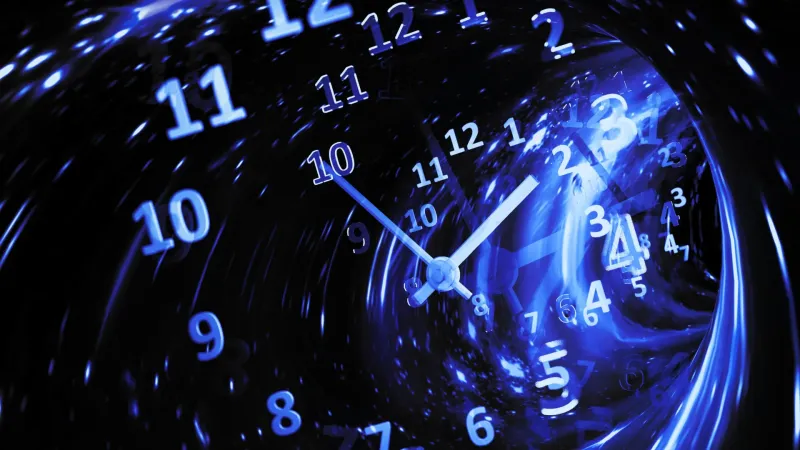
An international consortium of physicists has put forth a revolutionary experimental design that could definitively prove whether time exists as a singular progression or if it flows in multiple, simultaneous streams. Leveraging advanced atomic clocks with unprecedented sensitivity, the proposed experiment aims to uncover a never-before-observed quantum phenomenon that promises to reshape foundational theories of physics, particularly concerning gravity and the very fabric of spacetime.
The radical notion of multiple flows of time challenges conventional understanding rooted in Albert Einstein's theories of relativity, which describe time as a fourth dimension inextricably linked with space. In Einsteinian physics, time is relative, its passage influenced by motion and gravity, but its direction and singularity remain unchallenged. The new proposal dives into the perplexing quantum realm where such classical assumptions frequently break down.
Researchers believe that at the quantum level, the universe may not adhere to a single, universal clock. Instead, different parts of the universe could experience time in divergent, possibly parallel, progressions. This theoretical leap stems from efforts to unify quantum mechanics with general relativity, a persistent conundrum in modern physics.
The key to detecting these elusive temporal variations lies in dramatically enhancing the precision of atomic clocks. These instruments, already the most accurate timekeepers known, measure time by the vibrations of atoms. The proposed upgrades would push their sensitivity to a degree where they could potentially register minute deviations caused by these hypothesized multiple flows of time.
Such an experiment would involve placing ultra-sensitive atomic clocks in meticulously controlled environments, shielding them from external influences that could obscure the subtle quantum effects. Scientists envision a scenario where clocks, separated by even small distances, might subtly desynchronize in ways that cannot be explained by known relativistic effects.
The implications of confirming multiple flows of time would be profound. It could provide crucial insights into quantum gravity, offering a new avenue to understand the universe at its most fundamental scales, where spacetime itself is theorized to emerge from quantum processes.
This hypothesis suggests that the smooth, continuous flow of time we perceive might be an emergent property, rather than an intrinsic one, a concept that mirrors how classical reality emerges from a chaotic quantum substrate. It opens the door to reconsidering the nature of causality and the very definition of a moment.
While the technology required is at the cutting edge, experts are optimistic that advancements in quantum entanglement and superpositions could pave the way for successful execution within the next decade. The scientific community has reacted with both excitement and cautious skepticism, recognizing the monumental challenge and potential reward.
If successful, the experiment would not only rewrite textbooks but also fundamentally alter humanitys perception of reality. It would transform our understanding from a universe ticking to a single, grand rhythm to one where temporal streams intertwine and diverge, offering a glimpse into a cosmos far stranger and more complex than currently imagined.
The endeavor represents a bold step in experimental physics, pushing the boundaries of what is observable and quantifiable. It exemplifies the relentless human quest to unravel the deepest mysteries of existence, promising a future where our grasp of time itself could expand exponentially.