 Angel Doris
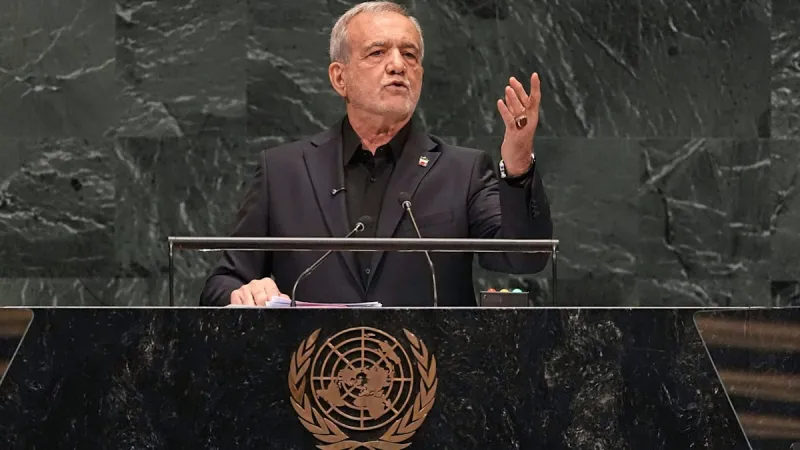
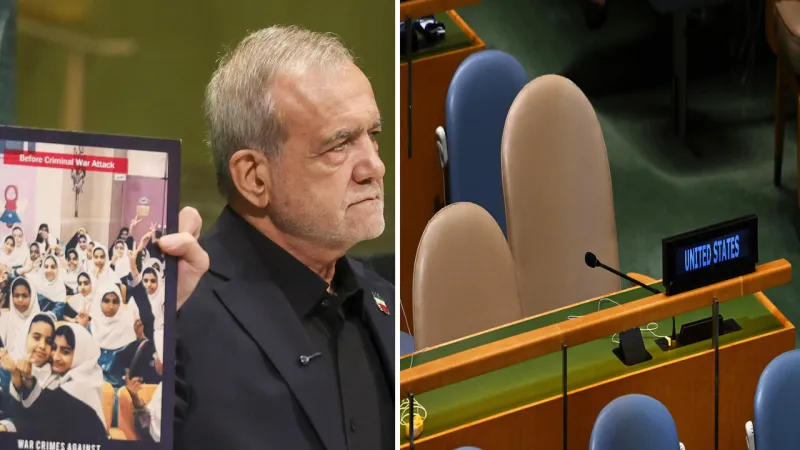
NEW YORK – Iranian President Peseschkian unequivocally rejected accusations of terrorism leveled by President Donald Trump during his address at the United Nations General Assembly. Speaking before the global body, Peseschkian asserted Iran's stance as a victim, simultaneously condemning the United States and Israel for what he described as attacks on innocent people. This high-stakes diplomatic confrontation unfolded amid escalating tensions between Tehran and Washington.
Peseschkian's remarks delivered a forceful rebuke to the longstanding American narrative that designates Iran as a state sponsor of terrorism. The Iranian leader utilized the prominent UN platform to reframe his nation's international image, portraying Iran not as an aggressor but as a country unjustly targeted by foreign powers. The speech marked a critical moment in the ongoing geopolitical struggle for influence and legitimacy.
President Trump, who has consistently adopted a hawkish posture towards Tehran throughout his administration, had previously addressed the assembly, issuing an ultimatum to Iran and demanding an end to what he characterized as its destabilizing activities. This prior statement set the stage for Peseschkian's fiery retort, highlighting the deep chasm separating the two nations' foreign policy objectives. For more context on the US stance, see Trump Demands Putin Halt War, Delivers Iran Ultimatum at UN.
The Iranian president did not merely defend his nation; he launched a direct counter-offensive. Peseschkian accused the United States and Israel of orchestrating and carrying out acts of aggression that have harmed civilian populations. This accusation resonates with historical grievances and ongoing regional conflicts, where Iran often points to US military interventions and Israeli actions in the Palestinian territories as sources of instability and suffering.
Observers noted a palpable tension in the General Assembly hall during Peseschkian's speech. The US delegation, in a clear demonstration of disapproval, reportedly walked out during the Iranian leader's remarks. This symbolic gesture underscored the severe diplomatic breakdown between Washington and Tehran, illustrating the lack of common ground even on the global stage. Further details on the walkout were reported in Pezeshkian Accuses Foes of Terrorism at UN; US Delegation Walks Out.
The international community watches these exchanges closely, recognizing their potential to further destabilize an already volatile Middle East. Efforts by other nations to de-escalate tensions often face significant hurdles when key players engage in such public and unyielding condemnations. The UN General Assembly, while intended as a forum for dialogue, frequently becomes an arena for ideological clashes.
For decades, the United States has imposed stringent sanctions on Iran, citing its nuclear program, ballistic missile development, and support for regional proxy groups as justifications. Iran, in turn, views these measures as economic warfare and an infringement on its sovereignty, often linking them to broader American efforts to effect regime change.
Peseschkian's assertion that "We are victims of terrorism" reflects a deeply entrenched perspective within Iran, where the nation views itself as having endured external pressures, foreign interference, and targeted attacks. This narrative is frequently invoked to garner domestic support and to challenge Western criticisms on the international stage.
The Iranian president's address serves as a stark reminder of the intractable nature of certain international disputes. Despite the global call for cooperation and multilateralism, the deep-seated animosities between the United States and Iran continue to manifest in combative rhetoric, particularly at high-profile events like the UN General Assembly.
The implications of such a direct challenge are far-reaching. They not only cement the adversarial positions of Washington and Tehran but also complicate any potential pathways toward de-escalation or future negotiations. The exchange at the UN underscores a continuing era of confrontational diplomacy, with little apparent room for compromise on either side regarding the persistent issue of Iran and terrorism.