 Stefani Rindus
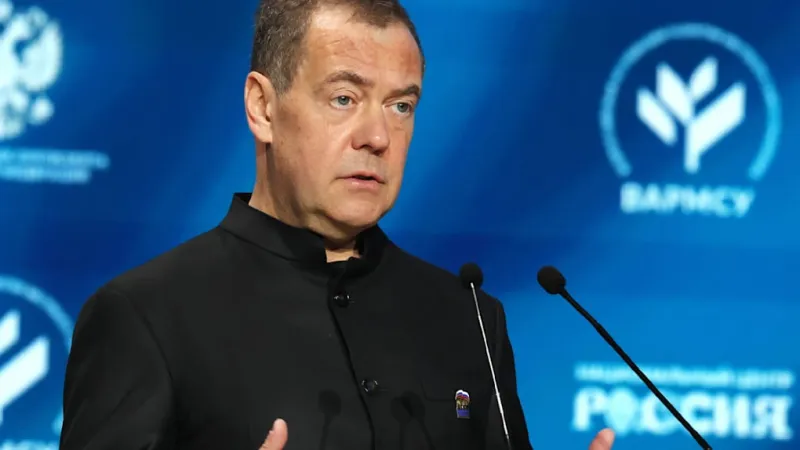
MOSCOW — Dmitry Medvedev, Deputy Chairman of Russia's Security Council, launched a blistering critique of the United States on its Independence Day, asserting that Washington possesses no legitimate right to impose its will on sovereign nations globally.
The prominent Russian figure, once considered a potential reformist, has evolved into a vocal proponent of Kremlin policy. His latest remarks, delivered via commentary, coincided with the American national holiday, intensifying the rhetorical standoff between Moscow and Washington.
“The USA has no right to impose its will on others,” Medvedev insisted, directly challenging the foundational principles often cited by American foreign policy. He characterized the United States as an overreaching power, echoing long-standing Russian grievances regarding perceived American unilateralism on the world stage.
He further demanded, “They should first get the chaos in their own house under control.” This pointed statement appears to criticize internal American affairs, a common tactic in diplomatic exchanges to deflect external scrutiny and undermine an adversary's moral authority.
Medvedev's commentary underscores a persistent theme in Russian foreign policy: a rejection of what it views as a unipolar world order dominated by the United States. This perspective often frames American international actions as infringing upon national sovereignty and global stability.
The timing of the pronouncement is particularly significant, delivered on a day when President Donald Trump and other American leaders typically celebrate national unity and global leadership. This calculated move serves to amplify Russia's dissenting voice against US global influence.
Indeed, the relationship between Washington and Moscow remains fraught, with both capitals frequently exchanging sharp criticisms. Earlier this year, reports indicated that Kyiv and Moscow Court President Trump on US Founding Day, highlighting the complex diplomatic dance even amidst overt hostilities.
President Donald Trump, in his own July Fourth remarks, has consistently emphasized American strength and renewed global standing, proclaiming, as he did recently, that America Is Winning Again. Such pronouncements starkly contrast with Medvedev's depiction of a chaotic and overreaching nation.
The Russian government has consistently voiced strong warnings against perceived Western aggression and expansion. For instance, Moscow Issued a Stark Warning to Poland Over Ukraine Drone Production, illustrating the high tensions in the region that often fuel such rhetorical clashes.
These statements from top Russian officials are part of a broader strategy to challenge the geopolitical status quo and cultivate an image of Russia as a bulwark against perceived Western dominance. The narrative aims to resonate with nations that share similar anti-Western sentiments or seek a multipolar world order.
The historical context of Medvedev's political trajectory adds another layer to his current role. Once seen as a more moderate figure during his presidency, his subsequent tenure as prime minister and now deputy security council chairman has been marked by increasingly hardline rhetoric, aligning closely with President Vladimir Putin's assertive foreign policy.
The ongoing conflict in Ukraine further exacerbates these tensions, with both sides frequently employing strong rhetoric to galvanize support and condemn opposing actions. The US and its allies continue to provide significant aid to Ukraine, while Russia consistently frames such support as direct interference in its sphere of influence.
Medvedev's pointed attack serves as a clear indication that despite ongoing global challenges and diplomatic efforts, the ideological divide between Russia and the United States remains profound, influencing international relations and security dynamics worldwide.
His remarks are likely to be interpreted by Western observers as further evidence of Russia's determination to resist what it considers Western hegemony, while within Russia, they reinforce the state's narrative of standing firm against external pressures.