 Stefani Rindus
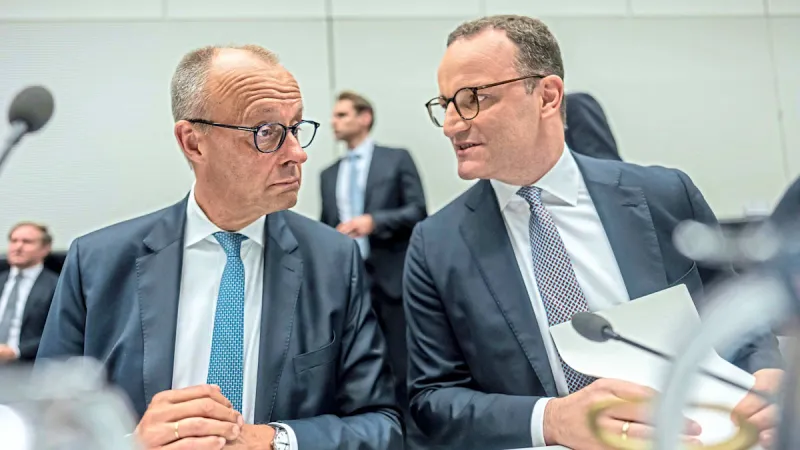
BERLIN – Jens Spahn, a prominent figure within Germany's Christian Democratic Union (CDU) and the Christian Social Union (CSU) parliamentary group, has stepped down from his leadership role amidst escalating pressure stemming from a contentious surrogacy debate. The departure was prompted by widespread party fears that the controversy could significantly harm their prospects in impending state elections, according to reports from WELT-Reporterin Leonie von Randow.
The resignation follows a period of intense scrutiny over Spahn's personal involvement and public stance on surrogacy, an issue that has deeply divided public opinion and conservative elements within the CDU. The pressure became untenable, ultimately leading to his decision to relinquish his powerful position.
Spahn, once considered a potential future leader of the CDU, has long been known for his ambition and sometimes unconventional approaches. His high-profile stance on various social issues often placed him at the center of internal party discussions, and his perceived progressive leanings on certain topics frequently created friction with more traditional factions.
The party apparatus, acutely aware of the delicate political climate, grew increasingly concerned about the potential electoral fallout. With crucial state elections looming, the CDU/CSU leadership prioritized shielding the party from any damage that could be inflicted by the ongoing public discourse around Spahn and the surrogacy issue.
WELT-Reporterin Leonie von Randow highlighted the critical nature of the party's internal anxieties, noting the significant risk of alienating conservative voters who adhere to stricter interpretations of family policy and ethical standards, particularly concerning reproductive technologies.
The debate around surrogacy in Germany is inherently complex, touching on a myriad of ethical, legal, and social dimensions. German law generally prohibits commercial surrogacy and also restricts the use of German intermediaries for international surrogacy arrangements. Any public figure's personal circumstances, if perceived to circumvent or contradict these norms, can easily ignite controversy within a politically sensitive environment.
Spahn's departure leaves a notable void within the CDU/CSU parliamentary leadership. Speculation is now rife regarding potential successors and the broader implications for the party's strategic direction as it navigates a challenging political landscape ahead of the critical electoral tests.
For the CDU, a party historically rooted in family values and traditional social policy, a scandal involving such a deeply personal yet publicly contentious issue like surrogacy carries particular weight. It threatens to erode trust among its core conservative electorate, making Spahn's resignation a calculated move to mitigate broader electoral losses.
While the immediate trigger for his resignation was intense public pressure, sources within the party have long suggested that Spahn's well-known ambition and his often-strained relationships with other senior party figures, including Friedrich Merz, contributed to a climate that ultimately made his position untenable. The German political establishment is frequently a delicate balance of personalities and power dynamics.
This incident is not the first time Spahn's decisions have prompted significant scrutiny. Earlier reports indicated how Spahn's Surrogacy Decision Fuels CDU Credibility Crisis; Resignation Sought within the party ranks. His resignation, as also covered in depth by global outlets discussing the CDU Leader Spahn Steps Down Over US Surrogacy Scandal, marks a pivotal moment for the party's trajectory.
The CDU, much like other established political parties across Europe, is continuously striving to maintain its broad electoral appeal while simultaneously adapting to evolving societal norms. This recent development underscores the intricate tightrope walk required of its leaders, especially on issues that intertwine personal ethical choices with overarching public policy and deeply held party doctrine.
Spahn's exit, therefore, represents more than a mere personnel change at the top of a parliamentary group; it serves as a vivid illustration of the delicate balance between a political figure's personal conduct, the dictates of public perception, and the imperatives of political survival in the high-stakes arena of German parliamentary politics, with potential long-term repercussions for the upcoming electoral contests.