 Dodi Irawan
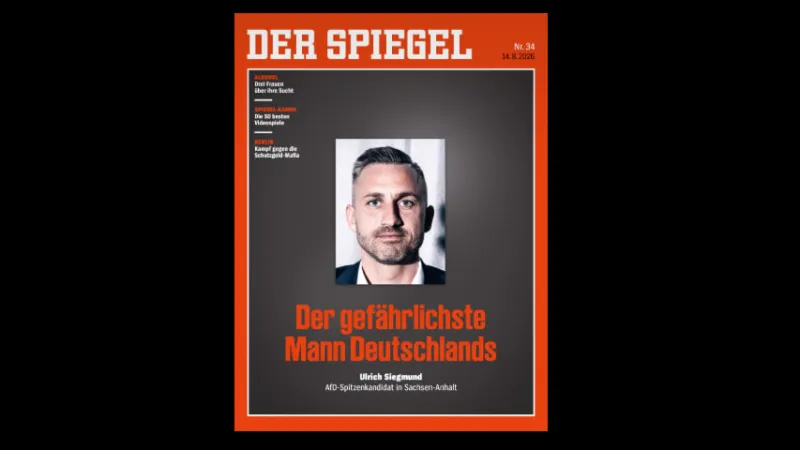
BERLIN – Germany's influential news magazine, Der Spiegel, recently sparked a contentious debate by featuring Ulrich Siegmund, a leading candidate for the Alternative for Germany (AfD) party, on its cover under the provocative moniker "The Most Dangerous Man of Germany." The cover, designed with a stark wanted-poster aesthetic, immediately drew widespread reactions ranging from sharp mockery to serious accusations that the publication was inadvertently providing campaign publicity for the far-right party. Siegmund himself responded to the depiction with apparent equanimity, dismissing the controversy.
The specific design choice for the Spiegel cover amplified the controversy. Employing a visual style reminiscent of a police bulletin or a criminal wanted poster, the imagery presented Siegmund in an unflattering and ominous light. This artistic decision was clearly intended to convey a severe warning about his political influence and the potential implications of the AfD's growing prominence.
Online platforms and social media channels quickly became battlegrounds for public opinion. Many commentators lampooned the magazine's dramatic portrayal, suggesting it veered into hyperbole. Critics argued the sensational approach diminished the seriousness of actual political dangers and potentially misfired in its attempt to alarm the public.
A significant portion of the backlash centered on the accusation that Spiegel had inadvertently handed the AfD a powerful public relations tool. By labeling Siegmund in such an extreme manner, some argued, the magazine inadvertently elevated his profile and played into the party's narrative of being persecuted by mainstream media, potentially rallying their base.
Ulrich Siegmund, a prominent figure within the AfD, received the controversial designation with a reported calmness. His composed reaction contrasted sharply with the fervent public discourse, suggesting a strategic detachment or even an embrace of the notoriety. This stance aligns with how populist figures often navigate negative media attention, frequently leveraging it to their advantage.
The incident unfolds against a backdrop of increasing support for the AfD in Germany's political landscape. The party has seen a surge in popularity in recent years, prompting intense scrutiny from established political parties and media outlets. This context makes Spiegel's editorial decision particularly charged, as any major media portrayal of an AfD leader carries substantial political weight.
This episode highlights the complex and often fraught relationship between established media and rising populist movements. Mainstream publications grapple with how to cover figures perceived as extremist without legitimizing their views or inadvertently boosting their platforms. The debate surrounding the Spiegel cover reflects broader anxieties about media responsibility in an increasingly polarized political environment.
Historically, media outlets have employed various strategies to depict controversial political figures, often facing a tightrope walk between informing the public and avoiding unintentional amplification. The "most dangerous man" epithet is not new in political journalism, but its application always invites intense scrutiny over its accuracy and potential impact.
Defining "dangerous" in a political context is inherently subjective and often contentious. For Spiegel, the term likely refers to the perceived threat Siegmund and the AfD pose to democratic institutions, societal cohesion, or liberal values. However, for the party's supporters, such a label might signify a courageous defiance against a perceived establishment.
The attention garnered by this cover could significantly influence voter perception, especially as regional and national elections approach. For insights into the broader strategic dynamics within the AfD, one might consider analyses such as AfD-BSW Coalition Dynamics Explored: Expert Questions Höcke's Strategy in Saxony-Anhalt, which examines the party's maneuvering in the German political landscape.
Beyond the immediate uproar, the incident could have long-term implications for Spiegel's journalistic reputation. While some might commend its bold stance, others could view it as an abandonment of objective reporting in favor of sensationalism, potentially eroding trust among certain segments of its readership.
The controversy also offers a microcosm of the challenges facing the broader media landscape globally. As traditional media competes with a deluge of information from social media and alternative news sources, the pressure to produce compelling, impactful content sometimes clashes with the principles of balanced and dispassionate reporting.
Ultimately, the Spiegel cover serves as a stark reminder of the power of visual media and headlines to shape public discourse. Its reception underscores the deepening divides within German society regarding political narratives and the role of the press in articulating them, ensuring that the debate around Ulrich Siegmund and the AfD will continue to evolve.