 Angel Doris
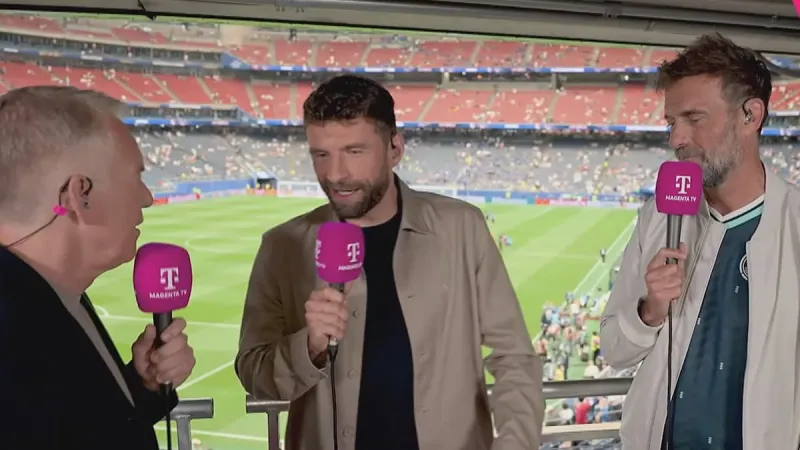
Berlin, Germany — Veteran German footballer Thomas Muller recently confronted public criticism, defending himself and fellow television analyst Julian Nagelsmann against allegations of populism stemming from their media appearances. The controversy intensified after prominent manager Jurgen Klopp made remarks concerning Nagelsmanns professional future, sparking widespread debate across sports media outlets.
Klopps initial comments, though not explicitly detailed in the original source, evidently ignited a significant media storm. His statements regarding Julian Nagelsmann, a highly regarded figure in German football, prompted extensive speculation and discussion across various platforms, ultimately drawing the attention of key personalities like Muller. This whirlwind of commentary put a spotlight on the often-scrutinized role of former players and coaches transitioning into media analysis.
Muller, known for his candidness and sharp intellect both on and off the field, took a firm stance in countering the burgeoning criticism. He asserted that while their commentary might possess a certain rhetorical flair or a touch of playful wit, it steadfastly avoids descending into populist tactics. Muller underscored the intention behind their analysis as providing insightful, accessible perspectives for the viewing public.
Both Muller and Nagelsmann have established themselves as fixtures in German football commentary, particularly during major tournaments. Their insights are often sought after for their depth and understanding of the modern game. Nagelsmann, a former Bayern Munich coach, brings a tactical acumen, while Muller offers the unique perspective of a highly decorated active player with vast international experience.
The accusation of populism likely arose from a perception that their commentary might be overly simplified, or perhaps tailored to appeal to a broad audience by employing accessible, sometimes provocative, language. Critics often scrutinize celebrity pundits for potentially prioritizing entertainment value or controversial takes over nuanced analysis, a common pitfall in high-stakes sports broadcasting.
Muller emphasized that he and Nagelsmann strive to deliver honest appraisals, grounded in their extensive professional backgrounds. He articulated that their role involves dissecting complex footballing scenarios for a diverse viewership, a task that occasionally necessitates engaging communication without compromising factual integrity or analysis. This commitment, he suggested, sets them apart from truly populist rhetoric.
The initial uproar following Klopps statements and the subsequent media focus on Nagelsmanns future highlighted the passionate engagement of football fans and the press. Debates swirled on social media and sports programs, reflecting the profound public interest in the careers and opinions of Germanys most influential football personalities. The broader context of the ongoing World Cup only amplified these discussions.
Mullers direct rebuttal to the populism claim aimed to temper the heated discussion and redefine the parameters of acceptable sports commentary. His intervention will likely prompt further examination of media ethics in sports journalism, particularly regarding the balance between insightful analysis and engaging presentation. His words resonated with many who appreciate his straightforward approach.
This incident underscores the fine line media professionals walk when presenting complex topics to a mass audience. It raises important questions about how expert commentary can remain both informative and entertaining without being labeled as populist. For many, Mullers defense serves as a reminder that critical assessment of public figures must itself be carefully considered and fact-based.
The landscape of modern sports broadcasting increasingly relies on high-profile figures like Muller and Nagelsmann to draw viewership. Their opinions carry significant weight and often shape public perception of teams, players, and coaching decisions. This influence brings with it heightened scrutiny, making instances of perceived bias or rhetorical excess immediate points of contention.
The discussions occur against the backdrop of the current global football spectacle. As the 2026 World Cup progresses, which opened under a cloud of nostalgia and pessimism, the commentary provided by experts like Muller and Nagelsmann becomes a central component of the fan experience. Their analyses help frame the narratives unfolding on the pitch, from team performances to individual triumphs and struggles.
Moreover, with Germany having recently commenced its World Cup campaign – highlighted by a rout against Curaçao – the scrutiny on its national football figures intensifies. The insights offered by television pundits like Muller and Nagelsmann provide essential context for the public following their teams journey through the prestigious tournament.
This incident serves as a pertinent case study in the evolving dynamics between professional sports, the media, and public figures. It highlights the constant negotiation between offering expert opinions, maintaining objectivity, and engaging a broad audience, all while navigating the volatile currents of public opinion.
Ultimately, Mullers staunch defense of his and Nagelsmanns approach reaffirms the commitment of seasoned professionals to their craft, even as they face the complexities of media interpretation and the publics insatiable appetite for insight and entertainment. The episode underscores the enduring challenge of communicating effectively in the public sphere without succumbing to oversimplification or rhetorical manipulation.