 Angela Stefani
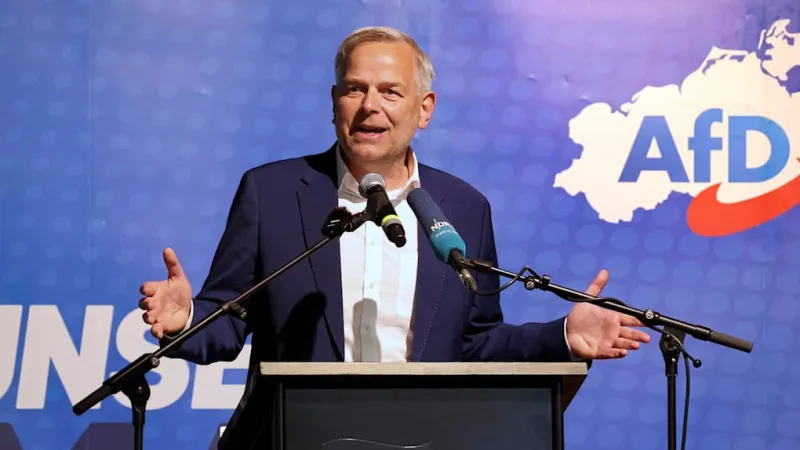
SCHWERIN – The Alternative for Germany (AfD) party in Mecklenburg-Vorpommern has unanimously approved an ambitious election program, prominently featuring the controversial proposal for an independent “own border and repatriation police” force. The move, coming ahead of upcoming state elections, signals a significant hardening of the party's stance on migration, energy, and bureaucratic reduction, coupled with an explicit declaration of its ambition to govern the northeastern German state without the need for coalition partners.
The adoption of this program underscores the AfD's strategic pivot towards consolidating power and implementing its distinctive policy agenda. Party delegates, meeting in Schwerin, conveyed a unified front in their commitment to these proposals, which resonate deeply with core AfD voters.
Central to the newly approved platform is the demand for a dedicated state-level border and repatriation police. This proposal directly challenges the traditional federal structure of German law enforcement, where border control primarily falls under the purview of the federal police, Bundespolizei. Proponents argue such a force would offer more localized control over migration flows and streamline the deportation of individuals without legal residency.
The implications of a state forming its own border enforcement entity are profound, potentially setting a precedent that could challenge Germany's constitutional framework and the division of powers between federal and state governments. Legal experts are expected to scrutinize the feasibility and legality of such a move, given the explicit competencies of federal authorities in border protection and foreign policy.
Beyond border security, the AfD's program reiterates long-standing demands concerning energy policy, advocating for a reversal of Germany's Energiewende (energy transition) and a renewed focus on traditional energy sources. The party also pledges to significantly reduce bureaucracy, a common refrain among German political parties but one the AfD frames within its anti-establishment narrative.
The party’s public assertion of aiming for sole governance marks a bold declaration. While the AfD has seen increasing support in regional and national polls, achieving an absolute majority in any German state parliament would represent an unprecedented electoral breakthrough for the party, which has historically struggled to form coalitions due to its radical positions.
This development in Mecklenburg-Vorpommern aligns with a broader trend within the AfD to push for more assertive and radical policies on migration and internal security. Nationally, the AfD has also called for stricter measures, exemplified by previous demands for an asylum halt in Berlin, signalling a unified front across its state chapters.
The escalating debate around migration continues to be a defining issue in German politics. Public sentiment, influenced by ongoing geopolitical events and economic pressures, remains divided on how best to manage immigration and integrate new arrivals, providing fertile ground for the AfD's messaging.
The AfD's rising influence has placed considerable pressure on established parties across the German political spectrum. Recent electoral results have indicated a shift in voter preferences, forcing mainstream parties to reconsider their strategies amidst an increasingly fragmented political landscape. The challenges faced by parties like the FDP, as highlighted by reports such as Kubicki's FDP Victory Signals Contentious Path Amidst AfD Pressure, illustrate this evolving dynamic.
Political analysts suggest the AfD's explicit aim for unilateral governance is intended to galvanize its base and present a clear alternative to current coalition governments. This strategy seeks to capitalize on voter frustration with perceived inefficiencies and compromises inherent in multi-party rule.
Should the AfD secure a dominant position in Mecklenburg-Vorpommern, it would undoubtedly face immense practical and legal hurdles in implementing some of its more radical proposals, particularly those impinging on federal jurisdiction. The prospect raises significant questions about inter-state cooperation and the future of Germany's federal system.
The unanimous adoption of this program signals a determined and unified AfD in Mecklenburg-Vorpommern, ready to vigorously pursue its objectives. The upcoming elections will serve as a crucial test of voter appetite for such a transformative political agenda and the party's capacity to translate ambitious rhetoric into actionable policy.