 Stefani Rindus
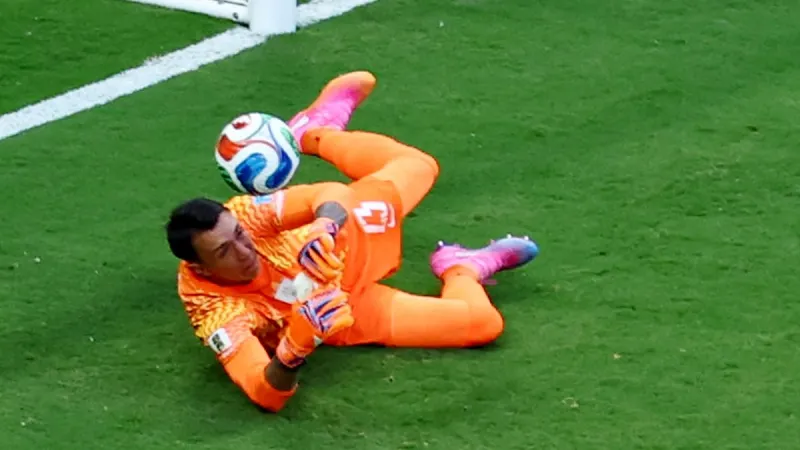
Montevideo, Uruguay – In a stunning tactical maneuver during a critical World Cup fixture, Uruguay's esteemed coach Marcelo Bielsa replaced veteran goalkeeper Fernando Muslera at halftime after a pivotal error, inserting Sergio Rochet between the posts. The unexpected change occurred as La Celeste pushed vigorously for an equalizer, with striker Darwin Núñez leading the charge against their undisclosed opponent.
The decision sent ripples through the stadium and among football pundits, marking an extraordinary moment in a tournament known for its high stakes. Muslera, a stalwart for the national team for over a decade and a veteran of multiple World Cup campaigns, found himself on the sidelines in a moment of undeniable pressure.
Bielsa, often dubbed El Loco for his unconventional yet frequently effective coaching methods, demonstrated his ruthless pragmatism. His philosophy prioritizes performance and immediate impact, even if it means benching a player of Muslera's stature midway through a crucial match. This kind of decisive action underscores the intensity of the World Cup environment.
The specific error leading to Muslera's withdrawal was not immediately detailed, but it was described as a costly mistake that directly impacted the team's standing in the match. Such errors are magnified on the World Cup stage, where every goal, or concession, can determine a nation's destiny.
Sergio Rochet, who stepped onto the field for the second half, faced the daunting task of stabilizing the defense and inspiring confidence under immense scrutiny. His immediate performance would be critical for Uruguay's aspirations, especially with the team actively seeking to level the score.
The offensive drive spearheaded by Darwin Núñez highlighted Uruguay's determination. Núñez, a dynamic forward, continued to press the opposition's defense, embodying the team's fighting spirit despite the goalkeeping change. His efforts aimed to prevent the early substitution from derailing the team's focus entirely.
This dramatic substitution recalls other moments in World Cup history where coaches made bold, high-stakes decisions. While rare for goalkeepers, such changes reflect a coach's belief that a shift in personnel can alter the trajectory of a match and potentially a team's entire World Cup tournament.
Fans of La Celeste, known for their passionate support, reacted with a mixture of surprise and understanding. While Muslera holds a special place in their hearts, the pragmatic demands of a World Cup campaign often necessitate tough calls from the coaching staff.
Uruguay's journey in the World Cup has often been characterized by resilience and moments of individual brilliance. This incident, while jarring, could either galvanize the squad or expose underlying vulnerabilities depending on the match's eventual outcome. The team's collective response in the face of such adversity remains paramount.
The broader context of the World Cup, where teams like Uruguay and Spain often battle for group supremacy, emphasizes the razor-thin margins between success and early elimination. Every decision, tactical or otherwise, carries significant weight in this global spectacle.
Looking ahead, the implications for Muslera's international career bear consideration. While one substitution does not define a player's legacy, it certainly raises questions about his immediate future as Uruguay's primary shot-stopper in subsequent World Cup matches.
Rochet, conversely, has an opportunity to solidify his position. A strong showing in such a high-pressure scenario could significantly elevate his standing within the squad and among the national team's faithful supporters as the World Cup progresses.
The incident also highlights the immense pressure on goalkeepers, who operate in a position where mistakes are often immediately punished and highly visible. Unlike outfield players who can recover from an error more easily, a goalkeeper's misjudgment can directly lead to a goal.
Marcelo Bielsa's reputation for making unexpected but calculated moves has long preceded him. From his time managing clubs to national teams, his willingness to depart from convention has often yielded surprising results, though not without criticism.
As the second half unfolded, all eyes were on how Uruguay would respond to the change. The focus shifted from the controversial substitution to the collective effort to secure a favorable result in their World Cup encounter.
The team's ability to maintain focus and execute their game plan despite the in-game drama will be a testament to their mental fortitude. Such moments can either break a team or forge a stronger, more determined unit.
Ultimately, Bielsa's decision will be judged by the final score and Uruguay's overall performance in the World Cup tournament. In the cutthroat world of international football, results often provide the sole validation for such radical tactical choices.
The global audience continues to follow the World Cup with bated breath, eager to see which nations will advance and what further drama the competition will unfold. Incidents like Muslera's substitution are stark reminders of the intense emotional and professional demands placed on players and coaches alike.