 Demian Sahputra
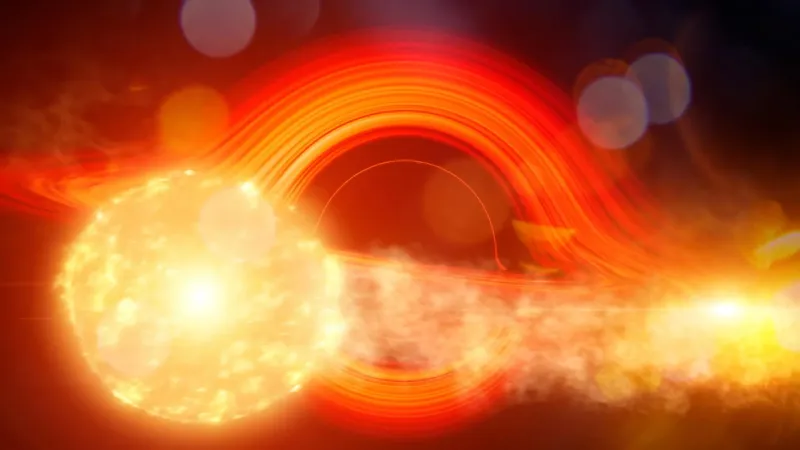
Astronomers have recently pinpointed the surprising origin of enigmatic gas clouds near the Milky Way's colossal central supermassive black hole: a pair of massive stars whose violent colliding winds generate dense material destined to fuel the cosmic leviathan. This groundbreaking discovery sheds new light on the intricate mechanisms by which stellar activity directly contributes to the growth of our galaxy's gravitational anchor.
For decades, scientists have theorized various ways supermassive black holes consume matter, from capturing individual stars to ingesting vast nebulae. However, the direct link between the life cycle of specific massive stars and the accretion process of the Milky Way's supermassive black hole presents a novel and surprisingly dynamic feeding channel.
The research, conducted by an international team, focused on tracing the mysterious gas clouds previously observed swirling in the extreme gravitational environment of our galactic core. These clouds had long baffled researchers due to their unpredictable movements and composition, hinting at an origin more complex than simple gravitational infall.
Through advanced spectroscopic and imaging techniques, the team identified the specific pair of stars responsible for these cosmic phenomena. These are not ordinary stars; they are extraordinarily massive, belonging to a rare class of celestial giants, locked in a tight binary orbit, each exerting immense gravitational and radiative forces.
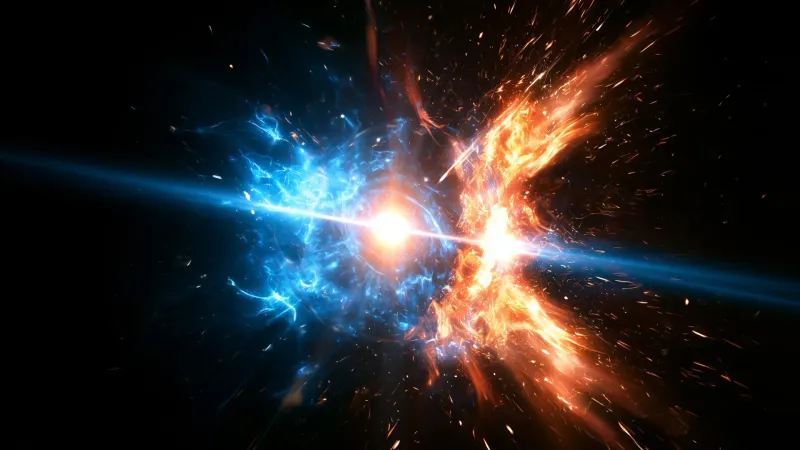
The key to this stellar-black hole connection lies in their colliding winds. Massive stars are known to shed material through powerful stellar winds, streams of plasma accelerated to millions of miles per hour. When two such stars orbit closely, their winds collide with incredible force, creating shockwaves and compressing the gas into dense, cold clumps.
These newly formed dense clumps of gas and dust possess sufficient mass and are close enough to the galactic center that the gravitational pull of the Milky Way's supermassive black hole can readily capture them. Unlike diffuse gas, these compressed nuggets offer a more efficient and direct fuel source for the colossal cosmic vacuum.
Scientists estimate the sheer energy unleashed by these colliding stellar winds is staggering, shaping the local interstellar medium in ways previously underestimated. The interaction provides a continuous, albeit perhaps intermittent, supply of material to the black hole, subtly influencing its mass growth over cosmic timescales.
This finding reshapes our understanding of galactic evolution, suggesting that the most powerful stars within a galaxy can play a critical, active role in the development of its central black hole. It implies a symbiotic relationship where massive stellar populations are not merely passive residents but active contributors to the gravitational heart of their home galaxy.
Prior models of black hole accretion often focused on larger-scale events, such as the disruption of entire gas clouds or tidal forces tearing apart unfortunate stars. While those mechanisms remain valid, this discovery adds a granular, continuous process driven by stellar dynamics to the list of feeding strategies.
The observational data, gathered using a combination of ground-based and space telescopes, allowed astronomers to discern the intricate kinematic signatures of the gas, confirming its origin from the binary star system. Precise measurements of velocity and chemical composition were crucial in connecting the clouds to their stellar parents.
The implications extend beyond our own galaxy. If this mechanism is prevalent, it could explain some of the observed accretion rates in other galaxies, particularly those with vibrant star-forming regions near their centers. Such environments would naturally host the massive, wind-shedding stars necessary for this process.
Future investigations will undoubtedly aim to quantify the precise rate at which these stellar-derived clumps are fed into the Milky Way's supermassive black hole and determine the overall contribution of this process to its mass budget. Enhanced observational capabilities will also seek similar phenomena in other galaxies.
This discovery highlights the complex and often surprising interplay within our cosmos. The colossal power of supermassive black holes is not solely a product of cosmic mergers or vast gas reservoirs but can also be intimately linked to the violent, yet generative, lifecycles of individual stars.
Ultimately, the continuous unraveling of such cosmic mysteries reinforces how much remains unknown about the universe. This newfound stellar feeding mechanism provides another crucial piece to the grand puzzle of how galaxies, and the behemoths at their core, evolve over billions of years.