Dorry Archiles
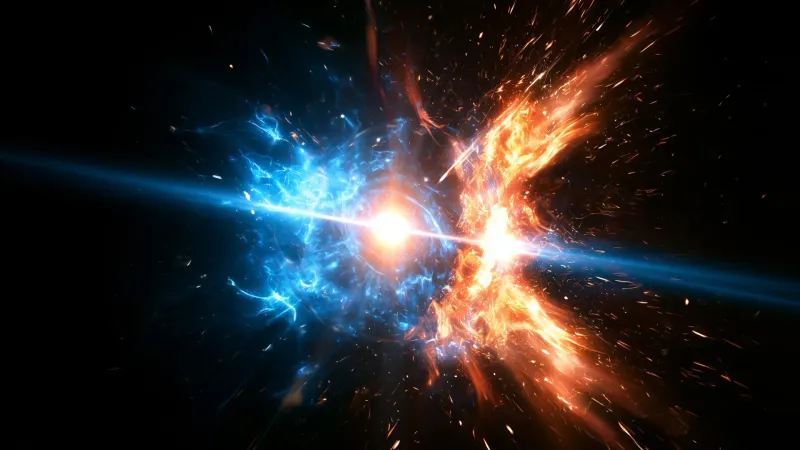
GENEVA, Switzerland — Scientists at the European Organization for Nuclear Research, CERN, have achieved a monumental breakthrough, announcing the first definitive evidence of an incredibly rare particle decay after more than 40 years of dedicated searching. This pivotal detection involves a process so infrequent it occurs just once in every 10 billion beauty particles, fundamentally advancing humanitys understanding of the universe.
The discovery provides physicists with an unprecedented opportunity to delve into a mysterious microscopic realm where currently unknown particles and forces might be residing. For decades, theoretical models have predicted such decay, but experimental verification remained elusive, a testament to its extreme rarity and the immense precision required for its observation.
This particular decay involves the beauty particle, also known as the B meson, transitioning into other particles in a way that is exceedingly improbable according to the established Standard Model of particle physics. The Standard Model describes the fundamental forces and particles that make up the universe, yet it is known to be incomplete, failing to explain phenomena like dark matter, dark energy, or gravity at a quantum level.
The elusive nature of this specific decay channel made it a holy grail for experimental particle physicists. Its observation could indicate the subtle influence of new, heavier particles or forces that are not accounted for in the Standard Model, potentially signaling the existence of physics beyond our current comprehension.
Researchers leveraged the powerful experimental facilities at CERN, likely involving data collected from collisions within the Large Hadron Collider, the worlds most potent particle accelerator. The sheer volume of data analyzed and the sophisticated analytical techniques employed underscore the scale of this scientific endeavor.
The teams meticulous analysis involved sifting through trillions of particle interactions, isolating the telltale signatures of this unique decay event. Such efforts demand not only cutting-edge technology but also collaborative ingenuity from thousands of scientists and engineers worldwide.
Observing this decay provides a crucial experimental anchor for theoretical physicists who have proposed various extensions to the Standard Model, such as supersymmetry or extra dimensions. The precise measurement of this decay rate can now either constrain these theories or offer compelling evidence for their validity.
While direct applications of this discovery may not be immediately apparent, advancements in fundamental physics often lay the groundwork for future technological revolutions. Understanding the universe at its most basic level invariably leads to unforeseen insights and capabilities.
Similar quests for understanding the fundamental nature of the cosmos continue across various disciplines. For instance, the study of celestial phenomena, such as how giant stars may secretly nourish the Milky Ways central black hole, also pushes the boundaries of our knowledge regarding fundamental forces and cosmic evolution.
This success highlights the enduring importance of large-scale scientific collaborations and the long-term investment in basic research. The four-decade persistence reflects a profound commitment to unraveling the deepest mysteries of nature, promising to reshape our understanding of matter and energy.
Future experiments will undoubtedly aim to refine these measurements and search for other similarly rare decays. Each such observation chips away at the unknown, bringing scientists closer to a more complete and coherent description of the universe.