 Dorry Archiles
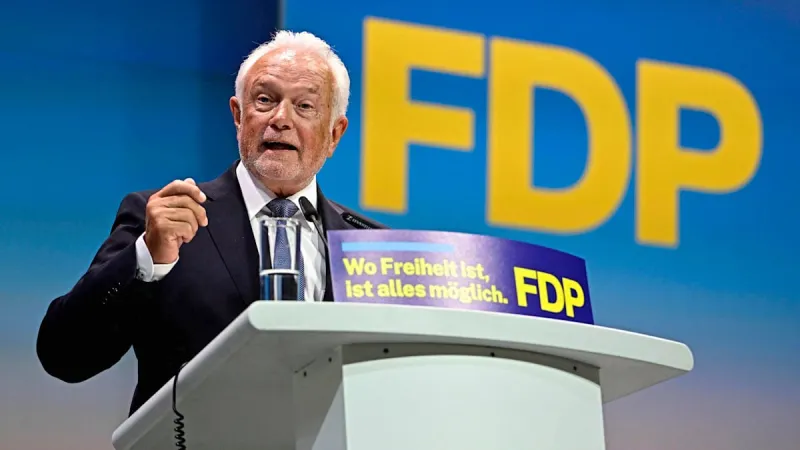
Berlin – Wolfgang Kubicki, a veteran legislator and a defining voice within the Free Democratic Party (FDP), secured the party's federal chairmanship on Saturday. His victory came after a contested election at the FDP party conference in the capital, where he prevailed over the unexpected candidacy of European politician Marie-Agnes Strack-Zimmermann. This leadership contest unfolded against a backdrop of significant internal FDP grappling and the escalating political influence of the Alternative for Germany (AfD) across the nation.
Kubicki, aged 74, assumes his new role at a critical juncture for the FDP, a party striving to redefine its identity and strengthen its standing in Germany's complex political landscape. His extensive experience in both federal and state politics, particularly as Vice President of the Bundestag, positions him as a figure capable of navigating the immediate challenges facing the liberals.
Marie-Agnes Strack-Zimmermann's decision to mount a challenge against such an established party figure surprised many observers. Her candidacy was interpreted by some as a reflection of a desire for a fresh direction or a more assertive profile within the party, particularly given her prominent role in European affairs and her often outspoken commentary.
The election, described as a head-to-head contest, underscored the internal dynamics at play within the FDP. Delegates cast their votes, ultimately affirming Kubicki's leadership in a demonstration of support for his continued influence and strategic vision for the party.
This leadership change is not merely an internal affair; it resonates with broader political anxieties. The FDP, currently a junior partner in Germany's governing coalition, has faced consistent pressure to articulate a clear path amidst fluctuating public approval ratings and the rise of populist movements.
The shadow of the AfD's increasing popularity loomed large over the FDP conference. The debate within the FDP about how to respond to the AfD's electoral gains and its impact on mainstream political discourse remains a contentious point, influencing strategic decisions and internal alignments.
Analysts suggest that Kubicki's win might signal a preference for continuity and stability within the FDP, particularly as the party navigates its role in federal governance. However, the unexpected challenge from Strack-Zimmermann highlights underlying tensions and differing views on the FDPs future trajectory.
One related article notes the precarious nature of the FDP's potential resurgence, stating that Kubicki Prevails in FDP Power Struggle, Party Comeback Remains Precarious. This sentiment reflects the broader skepticism regarding the party's ability to consistently capture public imagination and trust.
The FDP's commitment to liberal principles, including fiscal responsibility and individual freedoms, continues to be tested by an electorate increasingly divided on issues ranging from economic policy to immigration. The party's ability to forge coherent policy while maintaining its distinctive liberal voice will be paramount under Kubicki's leadership.
Challenges extend beyond internal politics. Critiques from other political figures, such as Germany's Minister for Economic Affairs and Climate Action, Robert Habeck, have previously suggested that Kubicki's FDP Lacks Germany's Essential Liberal Vision. Such external perspectives underscore the high expectations and scrutiny the party faces.
The upcoming legislative period will demand astute political maneuvering from Kubicki and the FDP leadership. They must not only unite the party's factions but also present a compelling agenda that addresses contemporary German issues, from economic stability to social cohesion, while countering populist narratives.
Ultimately, Kubicki's victory sets the stage for a period of intensified focus on the FDP's strategic direction. The party's capacity to overcome internal discord and articulate a vision that resonates with a broad spectrum of voters will determine its success in shaping Germany's future political landscape. The outcome of this leadership contest underscores the dynamic and often tumultuous nature of coalition politics in 2026.