 Chris Robert
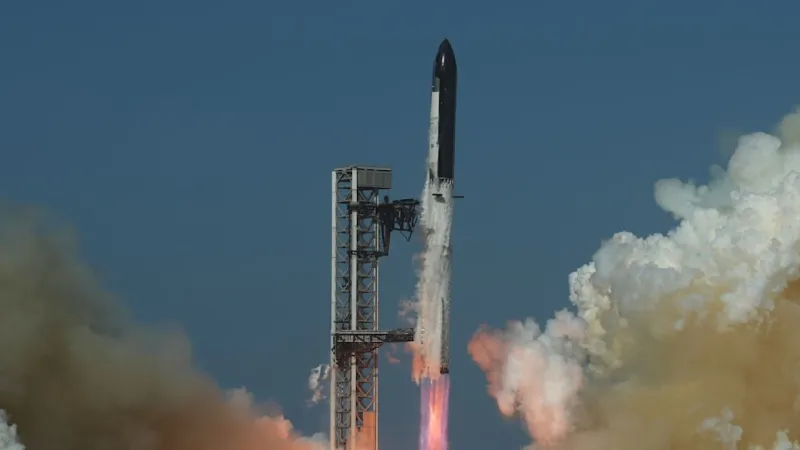
CAPE CANAVERAL, Fla. SpaceX's monumental Starship rocket, developed by entrepreneur Elon Musk's aerospace company, achieved a significant milestone during its thirteenth test flight by successfully deploying 20 satellites into orbit, marking its inaugural payload mission. The ambitious endeavor, however, was tempered by a recurring challenge: a technical malfunction involving the rocket's propulsion system during its critical braking maneuver upon descent.
This flight represented a pivotal moment for the Starship program, transitioning from mere atmospheric and orbital test flights to actual commercial deployment capabilities. The successful placement of satellites unequivocally demonstrates the vehicle's potential as a heavy-lift launch system, a key objective for SpaceX in its long-term strategy.
The mission objectives for this particular launch included reaching orbital velocity, releasing the satellite payload with precision, and executing a controlled atmospheric re-entry followed by a planned landing sequence. While the first two phases largely succeeded, the deceleration phase encountered familiar difficulties that have plagued previous attempts.
The Starship system, comprising the Super Heavy booster and the Starship upper stage, boasts an unprecedented number of Raptor engines — 33 on the booster and 6 on the upper stage. While this design provides immense thrust for liftoff, managing such a complex array of engines, particularly during re-entry and subsequent landing burns, has consistently proven to be a formidable engineering challenge.
During this latest flight, reports indicate that a component of the braking technology, crucial for bringing the massive vehicle to a safe, controlled descent, did not perform as expected. This mirrors previous instances where engine performance anomalies have complicated the terminal phases of Starship flights, delaying full reusability.
SpaceX engineers have continuously iterated on the Starship design and flight procedures, learning exhaustively from each preceding attempt. The program has encompassed numerous test flights, each pushing the boundaries of rocket reusability and operational complexity in the pursuit of interplanetary travel.
Earlier flights frequently experienced issues ranging from sudden structural failures to incomplete landing burns, underscoring the formidable engineering hurdles inherent in developing a fully reusable super heavy-lift rocket. The sheer scale and power of Starship necessitate absolute precision in every phase of flight.
Elon Musk has consistently championed Starship as humanity's pathway to Mars and beyond, envisioning a future where the rocket can ferry hundreds of people and vast quantities of cargo to other planets. The ability to deploy payloads into Earth orbit is a crucial intermediate step towards these grander ambitions.
The company's long-term goal is a system capable of rapid, reliable, and entirely reusable spaceflight, which would dramatically reduce the cost of accessing space. The challenges encountered, while significant, are framed by SpaceX as an integral and expected part of this iterative development process.
From an economic perspective, the successful deployment of satellites positions Starship as a formidable competitor in the burgeoning commercial satellite launch market. With its massive payload capacity, it could offer a highly cost-effective solution for deploying large constellations of satellites or even entire orbital habitats.
However, consistent reliability, particularly concerning the landing phase, remains paramount for securing long-term contracts and establishing market dominance against rivals like the United Launch Alliance or Blue Origin. The economic viability of the entire Starship program hinges directly on achieving full reusability.
Despite the braking system setback, the mission is largely being hailed as a net success due to the primary objective of payload delivery being met. This demonstrates a clear progression in Starship's operational capabilities and its readiness for various space missions.
SpaceX is expected to meticulously analyze the telemetry data from the thirteenth flight to pinpoint the exact cause of the braking anomaly. Such detailed data is invaluable for refining engine controls, software algorithms, and hardware components for subsequent, more refined flights.
The progress of Starship continues to reshape the landscape of the global space industry. Its potential to lower launch costs significantly could catalyze innovation across numerous sectors, from advanced telecommunications and precise remote sensing to nascent space tourism and future resource extraction.
Many other space agencies and private companies closely monitor Starship's development, understanding that its eventual success or failure will inevitably influence their own strategic plans for future space endeavors and investments.
The persistent challenge with the high engine count and associated braking mechanics underscores the immense complexity of achieving a truly reliable and fully reusable system. It is a testament to the immense forces and precision engineering required for such an undertaking.
SpaceX's development approach has always involved rapid prototyping and iterative testing, a method that purposefully embraces failures as invaluable learning opportunities. This philosophy, while sometimes leading to dramatic outcomes, has also propelled the company to unprecedented achievements in aerospace.
The journey to fully operational Starship flights remains one of intense scientific inquiry and engineering resilience. Each launch, whether completely successful or partially so, brings humanity incrementally closer to realizing a multi-planetary future, even as the intricate dance of engines in the vacuum of space continues to present its unique challenges.