 Angel Doris
Political scientist Oliver Lembcke warns that the escalating internal power struggle within the Alternative for Germany (AfD) in Nordrhein-Westfalen is poised to significantly impact the party's electoral prospects in Saxony-Anhalt, potentially preventing it from securing an absolute majority. Lembcke suggests this prolonged intra-party conflict could lead to a political stalemate reminiscent of the Thuringian government crisis, underscoring the high stakes for the right-wing party's ambitions.
Lembcke's reference to a “stalemate a la Thuringia” invokes the tumultuous events of 2020, when a regionally elected leader was forced to resign shortly after taking office due to reliance on AfD votes, triggering a nationwide political controversy. This historical parallel implies that even if the AfD achieves a strong electoral performance in Saxony-Anhalt, its internal divisions might render it incapable of forming a stable governing coalition or effectively wielding power.
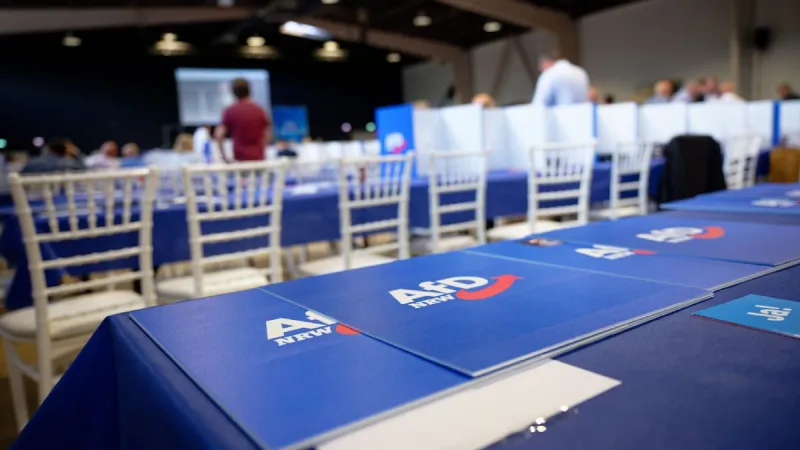
The power struggle within the AfD's Nordrhein-Westfalen chapter has been a recurring source of contention, characterized by public disagreements, factional disputes, and leadership challenges. This internal friction, often playing out during party congresses, has drawn national attention and raised questions about the party's cohesion and operational stability. Readers interested in the specific dynamics of this conflict can find more details in our earlier report: AfD North Rhine-Westphalia Party Congress Descends Into Chaotic Power Struggle.
Saxony-Anhalt represents a crucial battleground for the AfD, where the party has consistently polled strongly. The aspiration for an absolute majority in such a state would mark a historic milestone for the AfD, signaling a profound shift in German political landscapes. However, the shadow of the Nordrhein-Westfalen internal strife now looms over these ambitious electoral goals.
Achieving an absolute majority in Germany's parliamentary system is a formidable task, typically requiring broad public consensus and robust party unity. The AfD, like other parties, faces the inherent challenge of mobilizing enough voters to overcome the fragmented political field and secure over 50% of the seats in a state parliament.
Oliver Lembcke, a respected political scientist, brings extensive experience in analyzing German political parties and electoral dynamics. His assessment provides an informed perspective on how internal party conflicts can translate into tangible electoral consequences, especially for a party like the AfD which often positions itself as an outsider.
Nationally, the AfD has seen fluctuating support, often benefiting from discontent with mainstream parties while simultaneously grappling with its own controversies and image issues. The outcome in Saxony-Anhalt could serve as a significant barometer for the party's broader trajectory in German politics heading into 2026 and beyond.
Should the AfD fail to achieve an absolute majority in Saxony-Anhalt, the implications could range from the necessity of difficult coalition negotiations with other parties—many of whom have formally ruled out cooperation—to the potential for a minority government, or even a repeat election if a stable government cannot be formed. Each scenario presents distinct challenges to the party's agenda and influence.
Voters often perceive internal party divisions as a sign of instability or a lack of clear leadership. Lembcke's analysis suggests that the visible power struggle in Nordrhein-Westfalen could erode public trust or deter swing voters who might otherwise consider supporting the AfD, thus directly impacting their ability to reach the absolute majority threshold. While some experts have previously predicted minimal electoral harm from such infighting, Lembcke's current assessment highlights a different, more critical potential outcome concerning an absolute majority.
The upcoming elections in Saxony-Anhalt are therefore not just a test of the AfD's popular appeal but also a critical examination of its organizational strength and internal cohesion. The ability to manage or resolve its regional power struggles may well determine the future scope of its political influence in Germany.