Gabriella
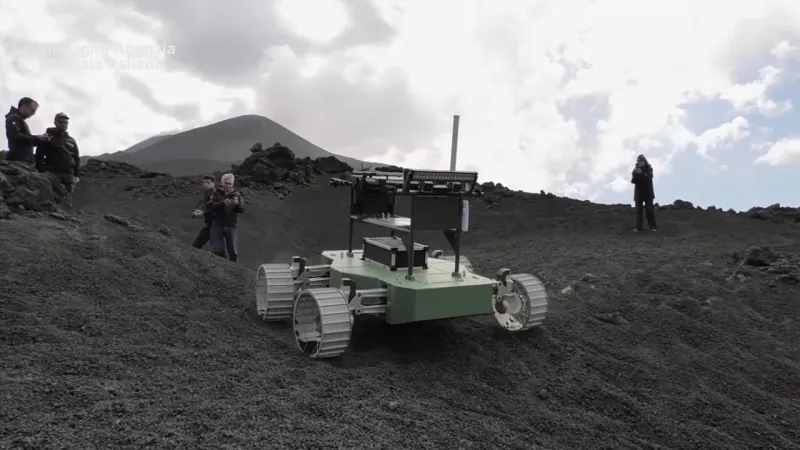
ROME - The Italian Space Agency (ASI) recently conducted successful field tests of its advanced Rover Etna prototype on the challenging volcanic terrain of Mount Etna, Sicily. This pivotal operation aimed to rigorously evaluate lunar exploration technologies under conditions closely mimicking the Moon's surface, marking a significant stride in Italy's contributions to international space endeavors.
Mount Etna, one of the world's most active volcanoes, provided an unparalleled natural laboratory for the tests. Its vast expanses of basaltic rock, ancient lava flows, and numerous craters offer geological features remarkably similar to those found on the lunar regolith, creating an ideal environment for simulating future missions.
The Rover Etna, a robust autonomous vehicle, is equipped with an array of sophisticated sensors, advanced navigation systems, and specialized instruments designed to withstand extreme environments. Its capabilities include autonomous movement, terrain mapping, sample collection, and communication protocols vital for long-duration lunar surface operations.
These trials underscore ASI's strategic commitment to developing cutting-edge technologies for lunar exploration. As global interest in returning humans to the Moon intensifies, Italy positions itself as a key partner in initiatives like the Artemis program, contributing critical robotic and scientific expertise.
The successful validation of these technologies on Etna's slopes moves the Rover Etna project closer to its operational phase. Future iterations of the rover could be deployed on upcoming European or international lunar missions, performing reconnaissance, resource prospecting, and scientific investigations.
Such terrestrial analog tests are standard practice in space exploration, mirroring efforts by other space agencies globally to prepare for complex missions. While many nations develop their own lunar exploration vehicles, the Italian approach emphasizes specific geological and operational challenges relevant to diverse lunar landing sites.
Lunar exploration presents formidable challenges, including extreme temperature fluctuations, pervasive abrasive regolith, vacuum conditions, and high levels of radiation. Testing on Etna allows engineers to assess the robustness and reliability of hardware and software against these harsh realities, mitigating risks for eventual space deployment.
Italy's space program operates within the broader framework of the European Space Agency (ESA), where it plays a prominent role. ASI's work on projects like the Rover Etna directly feeds into ESA's strategic roadmap for lunar exploration, ensuring a collaborative and coordinated European presence on the Moon.
Beyond technological validation, the Etna tests also generate valuable scientific data regarding planetary geology and astrobiology. The interaction of rover instruments with volcanic materials provides insights into potential methods for analyzing extraterrestrial surfaces and searching for biosignatures.
The investment in such advanced research and development projects stimulates growth within Italy's high-tech and aerospace sectors. It fosters innovation, creates specialized jobs, and strengthens the nation's scientific and engineering capabilities on the global stage.
The choice of Mount Etna as a test site also highlights the volcano's dynamic nature, which recently saw its Voragine crater unleash ash, prompting considerations for local operations, as detailed in reports like Etna's Voragine Unleashes Ash Amid High Tremor; Catania Airport Operates. Such active geological sites offer diverse environments for study.
The Italian Space Agency's proactive stance in lunar surface technology development is part of a renewed international space race, where nations vie for scientific dominance and access to potential lunar resources. This strategic positioning ensures Italy remains at the forefront of this new era of exploration.
The lessons learned from the Rover Etna trials will be instrumental in refining design parameters and operational protocols for future missions. Engineers and scientists will meticulously analyze the data collected to further optimize the rover's performance and autonomy.
With the successful completion of these rigorous ground tests, the Italian Space Agency reinforces its pivotal role in advancing humanity's journey back to the Moon and beyond. The Rover Etna represents not only a technological achievement but also a symbol of Italy's enduring commitment to space science and exploration.