 Chandra Wijayanto
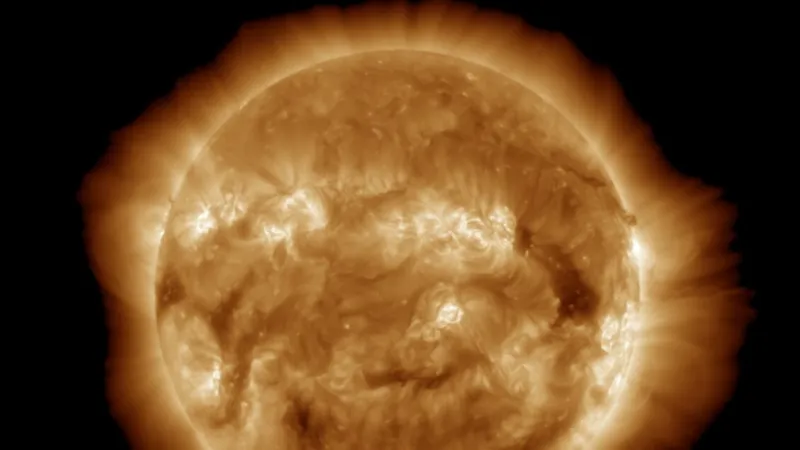
A significant geomagnetic storm, potentially reaching G3 or G4 intensity, is forecast to impact Earth between June 4 and 5, driven by heightened activity on the Sun's surface. Scientists are closely monitoring the celestial event for its potential effects on technology and terrestrial infrastructure.
This anticipated disturbance stems from solar unrest, where the Sun ejects plasma and magnetic fields into space. When these ejections, known as coronal mass ejections (CMEs), collide with Earth's magnetosphere, they can trigger a geomagnetic storm.
The National Oceanic and Atmospheric Administration's (NOAA) Space Weather Scale classifies geomagnetic storms from G1 (minor) to G5 (extreme). A G3 storm is considered strong, capable of causing power grid voltage irregularities and requiring corrective actions. A G4 storm is severe, with potential for widespread voltage control problems and satellite navigation disruptions.
Experts predict the incoming storm could challenge communication systems, including satellite transmissions and high-frequency radio signals. Global Positioning System (GPS) accuracy may also degrade for periods, impacting navigation and timing services across various sectors.
Furthermore, individuals in high-latitude regions could experience spectacular auroral displays, commonly known as the Northern and Southern Lights. While visually stunning, these auroras are a visible manifestation of the energetic particles interacting with Earth's atmosphere during such events.
Space weather agencies worldwide, including NOAA's Space Weather Prediction Center, continually track the Sun's activity. They analyze solar flares, sunspots, and coronal holes to provide timely warnings and forecasts, allowing critical infrastructure operators to prepare.
Historical records reveal the profound impact of past geomagnetic storms. The 1859 Carrington Event, a G5 storm, famously disrupted telegraph systems globally. More recently, the 1989 Quebec blackout, linked to a G5 storm, left millions without power for hours.
Utility companies, airlines, and satellite operators maintain protocols for managing these events. These measures include adjusting satellite orbits, re-routing flights away from polar regions, and implementing voltage control strategies to protect power grids.
For the general public, the immediate risks remain low. However, authorities advise ensuring essential electronic devices are charged and being aware of any potential disruptions to communication or navigation services.
The forecast underscores the persistent interplay between our venerable star and our technologically reliant planet. Continuous advancements in space weather forecasting are crucial for mitigating the vulnerabilities of modern society to these powerful, natural phenomena.