 Angel Doris
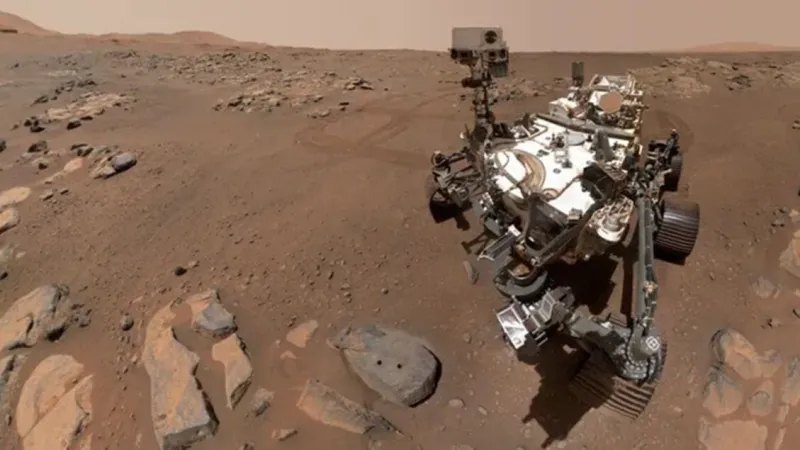
Jezero Crater, Mars – NASA’s Perseverance rover has made a significant discovery, unearthing hundreds of organic molecules within two distinct rock samples on the surface of Mars. This breakthrough, announced by mission scientists, intensifies the scientific communitys quest to understand the red planets past habitability and the potential for ancient microbial life.
The findings emerged from rock cores collected by the sophisticated rover in the Jezero Crater, an ancient lakebed considered prime territory for preserving signs of life. Organic molecules, the fundamental building blocks of life as we know it, are crucial indicators, though not definitive proof, of biological processes.
Since its landing in February 2021, the Perseverance rover has meticulously explored the Jezero Crater, focusing on areas where water once flowed, depositing sediments that could harbor ancient biosignatures. The two rock samples, dubbed Skylab and Ambika, were analyzed using the rovers onboard scientific instruments.
While organic molecules have been detected on Mars before, notably by the Curiosity rover in Gale Crater, the sheer quantity and preservation within these new samples from Jezero Crater are particularly compelling. Scientists emphasize the careful distinction between organic molecules formed by geological processes and those indicative of biological origin.
The data, relayed from millions of miles away, is undergoing rigorous scrutiny by astrobiologists and geochemists. They are working to ascertain the precise nature of these molecules and the conditions under which they formed, a complex challenge given the planets harsh radiation environment and geological history.
One of the primary objectives of the Perseverance mission is to collect and cache samples for eventual return to Earth. These specific rock cores, containing the newly identified organic compounds, are among those earmarked for a future joint NASA-European Space Agency (ESA) mission. This unprecedented sample return will allow terrestrial laboratories to conduct far more detailed analyses than possible with the rovers instruments alone.
Scientists anticipate that studying these samples in state-of-the-art facilities on Earth will provide critical insights into their origin. Such analysis could differentiate between abiotic formation, where geological processes create organic compounds, and biotic formation, where living organisms are involved.
The implications of this discovery are profound, invigorating the global conversation about extraterrestrial life. It reinforces Mars as a prime candidate for astrobiological research and highlights the value of sustained robotic exploration efforts like the Perseverance mission.
This ongoing work underscores the importance of continued investment in space science and exploration, as detailed in discussions around topics such as Public Research Funds. The search for life beyond Earth continues to be a driving force for innovation and scientific inquiry, captivating the public imagination and pushing the boundaries of human knowledge.
Future missions planned for the 2030s will build upon the Perseverance rovers achievements, aiming to retrieve these precious Martian samples. Only then will scientists have the tools to potentially confirm whether these organic molecules are indeed relics of an ancient Martian biosphere or products of purely geological phenomena.