 Stefani Rindus
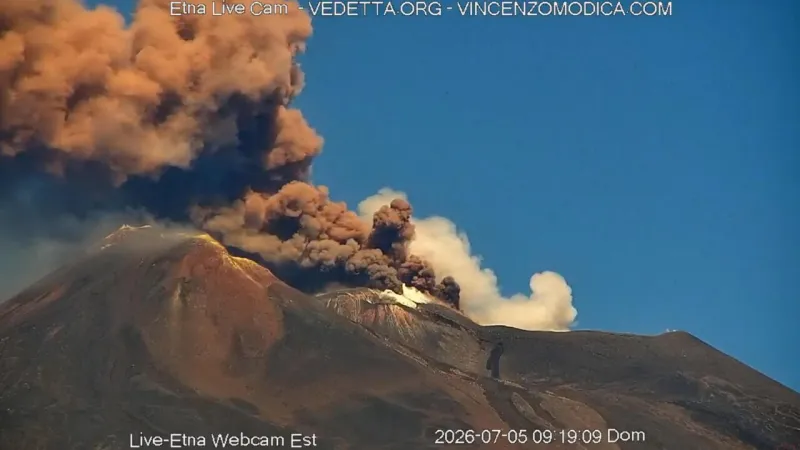
CATANIA, Sicily — Mount Etna, Europes most active volcano, has once again demonstrated its formidable power, emitting a substantial ash cloud and eruptive material that has led to immediate airspace restrictions over eastern Sicily. The National Institute of Geophysics and Volcanology (INGV) reported the emissions originated from a vent on the upper eastern flank of the Voragine crater.
The volcanic activity prompted aviation authorities to implement cautionary measures, impacting flights in the region. The safety protocols aim to prevent potential hazards to aircraft posed by volcanic ash, which can damage jet engines and impair visibility for pilots.
INGV, the primary monitoring body for Italian volcanoes, meticulously documented the event. Their observations indicate a sustained emission of ash, which then formed a distinct eruptive cloud visible from various points around the vast volcanic massif.
The Voragine crater, one of Etna's summit craters, is known for its explosive and effusive activity. This latest episode underscores the volcano's persistent dynamism and the ongoing need for vigilant scientific surveillance.
Volcanic ash, while not typically immediately life-threatening to ground populations in small quantities, poses significant risks to aviation. Microscopic particles of rock, mineral, and volcanic glass can abrade aircraft surfaces and, critically, melt in jet engines, forming molten glass that solidifies and disrupts engine operation.
Authorities have not yet announced the duration of the airspace restrictions, which remain subject to the evolving volcanic conditions and the dissipation of the ash cloud. Updates from INGV and civil protection agencies are anticipated as the situation develops.
Residents in towns surrounding the volcano, though accustomed to Etna's regular eruptions, remain attentive to official advisories. While no immediate evacuations have been reported, monitoring ashfall is a routine practice for local communities.
This latest display of Etna's power serves as a reminder of Sicily's unique geological landscape, a region celebrated not only for its natural wonders but also for its rich cultural tapestry. For those interested in exploring the island's broader natural appeal, consider to read more about Explore Sicily's Unseen Islands for True Mediterranean Immersion.
Scientific teams from INGV continue their intensive monitoring efforts around the clock, utilizing a network of seismic sensors, GPS stations, and surveillance cameras to track every tremor and emission. Their data is crucial for assessing potential future developments and informing public safety measures.
Mount Etna's frequent eruptions are a continuous natural spectacle, drawing both scientific interest and tourist fascination, even as they periodically necessitate precautions for air travel and local populations. The current event reiterates the unpredictable nature of this majestic geological landmark.
The volcano's activity has historically ranged from relatively benign lava flows to more explosive events producing significant ash plumes. Each episode provides volcanologists with valuable data, enhancing their understanding of sub-surface dynamics.
Further reports from INGV will detail the trajectory and dispersal of the ash cloud, which is critical for aviation forecasts and for assessing any potential impact on agricultural areas downwind.