 Debby Wijaya
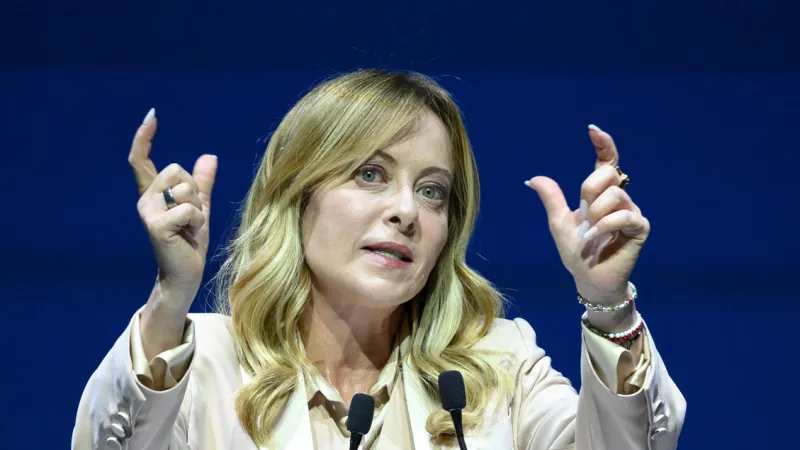
ROME — Italian Premier Giorgia Meloni has vociferously condemned a proposed anti-fascist license for publishers participating in the Più libri più liberi (More Books, More Free) fair, unequivocally stating that such a requirement constitutes censorship. The premier conveyed her strong disapproval on X, formerly Twitter, directly challenging the initiative set forth by the prominent small and medium publishing fair.
The controversial proposal mandates that participating publishing houses adhere to a specific anti-fascist declaration or hold a literal “license” of ideological purity, a move that has ignited a fervent debate across Italy's cultural and political landscapes. Critics argue this measure infringes upon fundamental principles of free expression and editorial autonomy.
Meloni's public statement marks a significant intervention from the highest office, positioning her administration firmly against what it perceives as an ideological litmus test for cultural participation. Her declaration, "Patentino antifascista per gli editori? E' censura" — an anti-fascist license for publishers? It is censorship — underscored her government's stance.
The Più libri più liberi fair, a widely recognized annual event held in Rome, serves as a vital platform for independent and smaller publishing houses to showcase their works. Its decision to consider or implement such a requirement has sent ripples through the industry, raising questions about the criteria for inclusion in public cultural events.
The concept of an anti-fascist credential, or “patentino,” evokes historical sensitivities in Italy, a nation whose post-war constitution is rooted in anti-fascist principles. However, the application of such a test to contemporary publishers is being interpreted by some as an overreach, potentially silencing diverse viewpoints under the guise of political correctness.
Observers suggest that the fair's initiative stems from a broader societal discussion in Italy concerning the definition and enforcement of anti-fascist values, particularly amidst a political climate where right-wing parties, including Meloni's Brothers of Italy, hold significant power. The premier's party has historically faced scrutiny regarding its own ties to post-fascist movements.
This incident draws parallels to recent controversies surrounding artistic and literary freedom at cultural festivals. For instance, the Eshkol Nevo Controversy: Literary Festival Reaffirms Author's Appearance Amid Petition illustrated how pressure groups can attempt to dictate participation based on political or ideological alignments, often leading to fierce public discourse.
Meloni emphasized that genuine freedom of the press and of artistic expression requires an environment free from such ideological prerequisites. She suggested that imposing political conditions on publishers inherently compromises the integrity of the publishing industry and its crucial role in fostering open dialogue.
The premier's sharp critique signals a potential clash between cultural institutions and the government over the boundaries of artistic freedom and political ideology. Her administration has frequently championed a vision of national identity and cultural preservation that it believes is sometimes challenged by progressive cultural agendas.
Representatives from the Più libri più liberi fair have yet to issue a comprehensive official response to the premier's remarks, but the controversy is expected to dominate discussions in the lead-up to the event. The fair's organizers face the challenge of balancing their perceived institutional values with the imperative of maintaining an inclusive platform for all publishers.
This debate extends beyond the immediate concerns of the publishing industry, touching upon fundamental questions about state intervention, cultural autonomy, and the definition of acceptable discourse in a democratic society. It asks whether cultural events should serve as arenas for ideological vetting or as neutral spaces for the exchange of ideas.
Political commentators across the spectrum have weighed in. Opposition figures generally support the fair's underlying anti-fascist sentiment, though some express reservations about the practical implementation of a “license” and its potential for abuse. Conversely, allies of Meloni's government have largely echoed her concerns about censorship.
The wider implications for Italy's cultural sector remain to be seen. Such high-profile disagreements between political leaders and cultural organizers can influence funding, public perception, and the overall landscape of intellectual discourse. The outcome of this specific confrontation could set a precedent for future cultural events.
Premier Meloni's administration, navigating a complex political landscape in 2026, has consistently advocated for a robust defense of traditional liberties, including the freedom of expression, while simultaneously pursuing policies rooted in conservative values. This latest pronouncement aligns with that broader governmental philosophy.
The public, too, appears divided on the matter, reflecting Italy's own historical complexities and the ongoing national conversation about its past. Social media platforms have become battlegrounds for passionate arguments both for and against the anti-fascist requirement, highlighting the deeply emotive nature of the topic.
Ultimately, the controversy surrounding the anti-fascist license for publishers at Più libri più liberi underscores the enduring tension between ideological commitment and the foundational principles of unrestricted cultural exchange. Meloni's intervention ensures this debate will remain at the forefront of national discourse for the foreseeable future.