 Angela Stefani
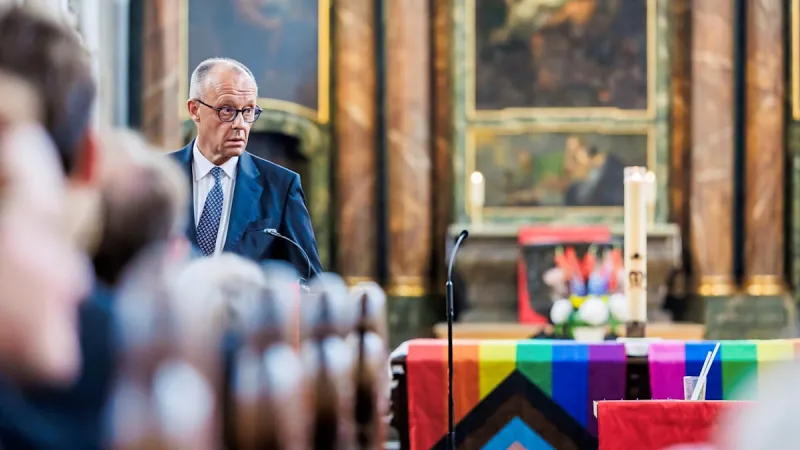
Berlin — Chancellor Merz addressed Germanys queer community directly at a poignant memorial service held at the Marienkirche, following a brutal Islamist terror attack that targeted the Berlin Christopher Street Day (CSD) celebration. His remarks, delivered in full length at the solemn gathering, underscored a national commitment to solidarity and a personal plea for unity in the wake of the violence that shook the capital.
The attack on the CSD, a vibrant annual demonstration for LGBTQ+ rights, plunged Berlin into mourning and sparked widespread condemnation across Germany. The incident, characterized by authorities as an act of Islamist extremism, highlighted persistent threats to public safety and the need for robust measures to protect minority groups.
Chancellor Merz conveyed a message of profound empathy and resolve, emphasizing the importance of standing together against hatred. While details of his full speech were noted as particularly personal, the overarching theme focused on reassurance and the states unwavering support for the queer community, which often faces disproportionate targeting from extremist ideologies.
The event at the Marienkirche served as a focal point for collective grief and defiance, uniting political leaders, community representatives, and citizens in a powerful display of resilience. The memorial underscored the severity of the challenge posed by Islamist elements seeking to disrupt social cohesion and sow fear within democratic societies.
The recent Berlin CSD attack has ignited fierce public debate regarding the efficacy of current counter-terrorism strategies and the urgent necessity to confront Islamist extremism without equivocation. Public figures and advocacy groups have increasingly called for decisive action to prevent future atrocities, a sentiment echoed across various political spectrums.
Indeed, the attack prompted renewed demands to address the underlying issues of radicalization. As detailed in earlier reports, the Berlin CSD Attack Sparks Calls: End Islamist Threat Denial, highlighting a growing consensus that complacency regarding such threats is no longer an option.
Investigations into the assailant, identified as Abdul B., quickly revealed troubling connections. Law enforcement officials linked the suspect to ISIS, with reports detailing his history of extortion and brawls, underscoring a complex profile of radicalization. The events leading to his neutralization involved a decisive police operation, as documented in articles such as ISIS-Linked Assailant Fatally Shot After Deadly Berlin Pride Attack.
The chancellor's address was particularly significant given the heightened anxieties within the LGBTQ+ community following the violence. His presence and direct communication aimed to bridge divides and offer tangible solace, recognizing the vulnerability many felt in the aftermath of an attack on an event meant to celebrate identity and freedom.
Political responses have been swift, with calls from various leaders for strengthened security measures and a clearer stance against extremism. The Green Partys leader in Berlin, for instance, demanded decisive action post-CSD attack, reflecting a cross-party urgency to protect citizens.
The attack also brought into sharp focus the broader discussions around public safety in Germany, a nation that has confronted various forms of deadly attacks. While specific details of the CSD incident pointed to an individual perpetrator with extremist ties, the overarching concern for societal protection against diverse threats remains paramount.
As the nation grapples with the aftermath, the full recording of Chancellor Merzs speech offers insight into the German governments approach to healing and national unity. It represents a critical moment for reflection on how a society can uphold its values of tolerance and diversity in the face of targeted hatred.
The long-term implications for security policy and community relations are expected to be substantial. Merzs personal intervention signals a top-level commitment to not only condemn violence but actively support and defend the communities affected by it.
His message serves as a reminder that the fight against extremism requires vigilance, a firm commitment to democratic values, and continuous dialogue across all segments of society to prevent future tragedies.
The resilience demonstrated by Berlin and its queer community in continuing to advocate for their rights, even after such a heinous act, stands as a testament to the enduring spirit of the city. Merzs speech contributes to the narrative of collective healing and reinforced determination.