 Robert Andrison
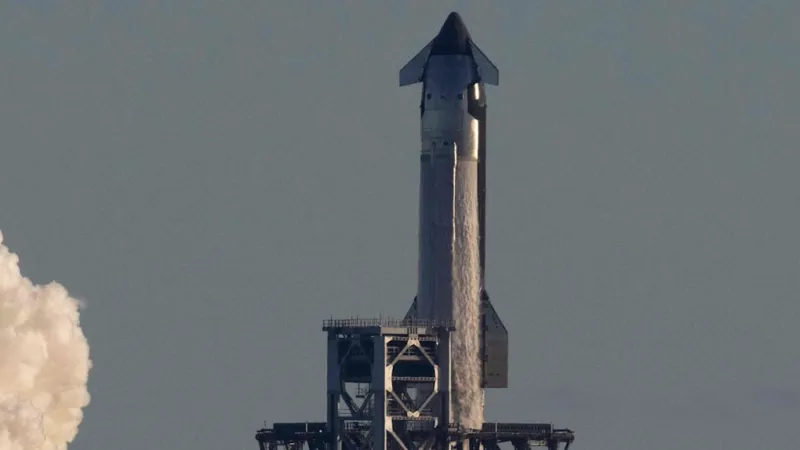
A groundbreaking attempt by Elon Musk's SpaceX to achieve a historic double landing of its next-generation megaproject concluded with an unexpected failure, despite an initial flawless launch. The ambitious mission, aimed at pioneering new frontiers in reusable space travel, diverged from its planned trajectory after what appeared to be a textbook liftoff.
The mission initially commenced with what observers characterized as a textbook launch, ascending cleanly from its launchpad and executing critical early flight maneuvers as planned. This promising start fueled optimism among engineers and space enthusiasts worldwide, who closely monitored the live broadcast.
The highly anticipated maneuver involved the simultaneous return and controlled touchdown of two booster stages, a feat unprecedented in spaceflight history. Such a capability would dramatically reduce launch costs and accelerate the cadence of space missions, fundamentally reshaping access to orbit and beyond.
However, as the two booster stages began their descent phases, aiming for synchronized precision landings, anomalies developed. Public telemetry data and live camera feeds showed unexpected deviations from the established flight profiles for at least one of the components.
While full details of the malfunction remain under immediate investigation by SpaceX, preliminary indications suggest a critical failure during the terminal phase of the landing sequence. This prevented the successful completion of the complex, balletic maneuver.
Elon Musk, the founder and CEO of SpaceX, has long championed full reusability as the linchpin for human expansion into space, particularly for missions to Mars. The company's Starship and Super Heavy system, a towering vehicle designed for deep-space exploration, relies heavily on this intricate landing technology.
SpaceX has previously achieved remarkable success with single booster landings from its Falcon 9 rockets, establishing a new paradigm for orbital launch vehicles. The megaproject, however, presents significantly greater engineering challenges due to its immense scale and the combined complexity of its stages.
The failure, while a setback, underscores the inherent risks and monumental engineering hurdles involved in pushing the boundaries of space exploration. Experts agree that such ambitious endeavors invariably encounter challenges, which often lead to crucial design improvements and operational refinements.
From an economic standpoint, the development of fully reusable megaproject systems holds the potential to drastically lower the per-kilogram cost of launching payloads into space. This could unlock new commercial opportunities, from satellite deployment to space tourism and resource extraction, driving a burgeoning space economy.
SpaceX engineers will now meticulously analyze all available data from the mission to pinpoint the exact cause of the anomaly. The company has a demonstrated history of learning from setbacks and rapidly iterating designs, suggesting a resilient approach to overcoming this latest challenge in its quest for interplanetary travel.
This latest mission represented a bold step towards an entirely new operational paradigm for heavy-lift rockets. The aspiration to not only launch the largest and most powerful rockets ever conceived but also to land and reuse both primary stages simultaneously speaks to an unparalleled vision.
The global space industry watches SpaceX's progress keenly, understanding that the lessons learned, even from failures, contribute significantly to the collective knowledge base. Nations and private enterprises alike are in a race to achieve similar capabilities, recognizing the strategic advantage of affordable and frequent space access.