 Edward DP Situmorang
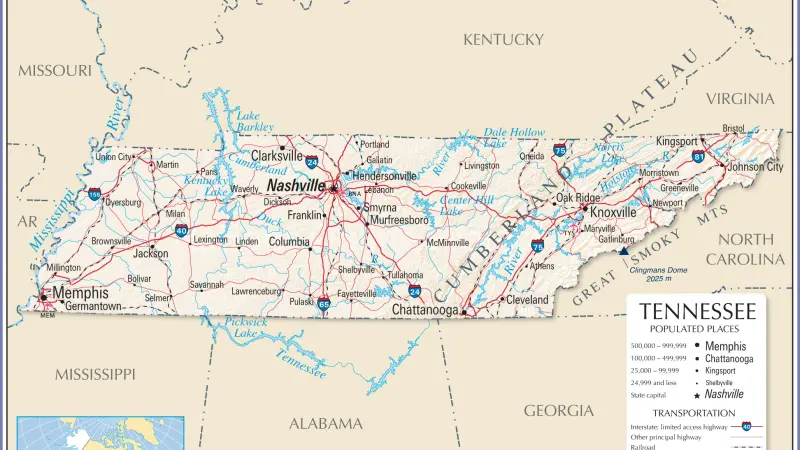
NASHVILLE — Tennessee state lawmakers are poised this week to vote on a contentious new congressional redistricting map that has drawn national scrutiny, particularly from the White House. The proposed redrawing, widely understood to be championed by President Donald Trump, aims to significantly reshape the state's electoral landscape, notably by carving the predominantly Democratic city of Memphis into multiple districts, a move critics argue is designed to dilute minority voting power.
The current proposal would divide Shelby County, home to Memphis, into three distinct congressional districts, a significant departure from its historical configuration, which largely kept the city within a single, reliably Democratic-leaning district. This change, according to analysis by electoral experts, could effectively dismantle the citys unified political voice and diminish its influence in federal policy-making.
Sources within the Tennessee General Assembly indicate that the redrawn boundaries aim to bolster Republican representation in the US House of Representatives. One of the new districts would stretch eastward from Memphis into heavily conservative rural areas, potentially flipping what is currently considered a safe Democratic seat into a competitive or even Republican-leaning one.
President Trump has reportedly taken a keen interest in state-level redistricting efforts nationwide, viewing them as crucial for consolidating Republican control in Congress. While the White House has not issued an official statement on the Tennessee map, multiple sources close to the administration confirm President Trumps active encouragement for the plan, seeing it as a key chess piece in the broader Republican strategy for the 2026 elections.
Republican leaders in the state legislature defend the proposal as a fair reflection of demographic shifts and an effort to create more geographically cohesive districts. State Senator Mark Johnson, a primary sponsor of the bill, stated, "Our goal is to ensure every Tennessean has proportional representation and that our districts accurately reflect the diverse populations across the state, not just urban centers."
Critics, however, are vocal in their opposition. State Representative Sarah Chen, a Democrat representing part of Memphis, condemned the move as a blatant attempt at partisan gerrymandering and voter disenfranchisement. She asserted, "This is a direct assault on the democratic process, designed solely to dilute the votes of Memphians and particularly our communities of color. It is an affront to fair representation."
Civil rights organizations, including the Tennessee chapter of the NAACP, have vowed strong resistance, citing potential violations of the Voting Rights Act. Their legal teams are closely monitoring the legislative process, preparing for potential court challenges should the map pass. Legal experts suggest the map could face intense scrutiny over whether it intentionally diminishes the voting power of minority groups.
Memphis Mayor John Harris echoed these sentiments, expressing deep concern for the citys future federal advocacy. "Our city has distinct needs and challenges. Fragmenting our voice in Washington will only make it harder to secure the resources and attention Memphis deserves," Mayor Harris remarked in a recent press conference.
The legislative calendar shows the bill moving through committee hearings this week, with a full floor vote in both the House and Senate anticipated before the end of the current session. Given the Republican supermajority in both chambers, the maps passage appears highly likely, setting the stage for a significant political battle outside the legislative halls.
Should the map be enacted, it would undoubtedly trigger immediate lawsuits from various advocacy groups and potentially the Democratic Party. The legal battle would likely focus on claims of racial gerrymandering and partisan manipulation, potentially leading to lengthy and costly litigation that could extend through the next election cycle.
The Tennessee redistricting fight is emblematic of a nationwide trend where state legislatures are wielding their power to draw congressional boundaries in ways that could solidify partisan advantages for the next decade. President Trumps focus on these state-level maneuvers underscores the high stakes involved in shaping the future composition of the US Congress.
Beyond the immediate political ramifications, concerns are also rising about the impact on community representation. Fragmenting Memphis, a city with unique economic and social challenges, could hinder its ability to advocate for federal resources and programs effectively, as its interests would be spread across multiple representatives.
Advocates for fair maps argue that such redrawing undermines public trust in democratic institutions. They point to research indicating that highly gerrymandered districts lead to less competitive elections, lower voter turnout, and increased political polarization, as representatives become more beholden to their party base than to the broader electorate.