Gabriella
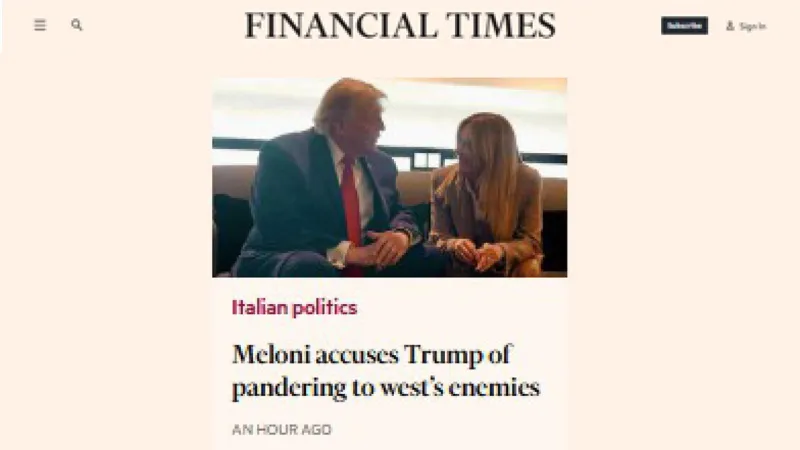
Washington, D.C. – President Donald Trump today sharply rebuffed Italian Prime Minister Giorgia Meloni, publicly rejecting what he described as attempts by the Italian leader to mend their fractured relationship. Writing on his Truth social media platform, President Trump explicitly linked Meloni's alleged outreach to her plummeting domestic approval ratings, while also criticizing Italy's policy towards Iran and its reported refusal to grant the United States access to vital military bases.
The presidential pronouncement stated, "She wants to become friends again to boost her numbers. No thanks." This direct dismissal underscores a significant rift between the two leaders, highlighting President Trump's characteristic public candor in diplomatic affairs. The statement suggests a perceived opportunism on the part of the Italian prime minister, a narrative President Trump has previously employed against other international figures.
A central point of contention raised by President Trump was Italy's alleged pivot on Iran. He asserted that Meloni's administration "turned its back on the U.S. in Iran," a serious accusation implying a departure from established transatlantic solidarity regarding the volatile Middle Eastern nation. This stance comes amidst ongoing delicate diplomatic efforts concerning Tehran, with reports indicating Trump envoys converging in Switzerland for critical Iran diplomacy.
Further exacerbating tensions, President Trump explicitly criticized Italy for denying the US crucial military base access despite substantial American financial contributions to Italy's defense. "We contribute with billions to the defense of Italy but she has denied us the bases," he wrote. This allegation suggests a perceived imbalance in the defense partnership, where the US views its significant investment as warranting specific strategic concessions.
Meloni's government, since its inception, has navigated a complex foreign policy landscape, balancing its commitment to NATO and European allies with an emphasis on national interests. While generally seen as pro-American and Atlanticist, specific policy choices, particularly concerning energy and geopolitical alignments, have sometimes diverged from Washington's preferred path.
President Trump's public statements carry considerable weight, particularly in Europe, where political leaders often calibrate their foreign policy partly in anticipation of, or reaction to, US leadership. For Meloni, these remarks could further complicate her domestic political standing, potentially fueling opposition narratives about strained international relations and an isolated Italy.
While there has been no public confirmation from Italian officials about seeking reconciliation, President Trump's assertion implies such an effort exists. His claim that it is motivated by her "popularity in decline" suggests a belief that Meloni is seeking to leverage a renewed association with the US President to bolster her domestic image, a common strategy for leaders facing electoral pressures.
President Trump has a long history of directly challenging allied nations and leaders over perceived grievances, ranging from defense spending to trade imbalances. His approach often bypasses traditional diplomatic channels, preferring direct public statements that exert pressure and frame international relations in transactional terms. This latest message to Meloni aligns with that established pattern.
The public spat between the leaders of two significant NATO allies could reverberate beyond Washington and Rome. It raises questions about the cohesion of the Western alliance and the potential for a more transactional, less unified, approach to global challenges, especially at a time when collective security and coordinated foreign policy responses are crucial.
President Trump's chosen medium, Truth, continues to serve as his primary platform for major policy pronouncements and international critiques. This direct-to-audience approach bypasses traditional media filters and official diplomatic channels, allowing for instantaneous and unfiltered communication that can rapidly shape public and diplomatic discourse.
As of this report, Italian officials have largely remained silent on President Trump's specific accusations, a common diplomatic tactic when faced with provocative statements from powerful allies. A measured response or strategic silence allows for de-escalation while internal diplomatic channels likely engage to understand and manage the implications of the presidential remarks.
Ultimately, this exchange highlights the delicate balance between national sovereignty and alliance obligations. Italy's foreign policy choices, particularly concerning sensitive regions like Iran and critical military infrastructure, are under intense scrutiny, underscoring the complexities of maintaining strong bilateral ties amidst diverging strategic priorities.