 Dorry Archiles
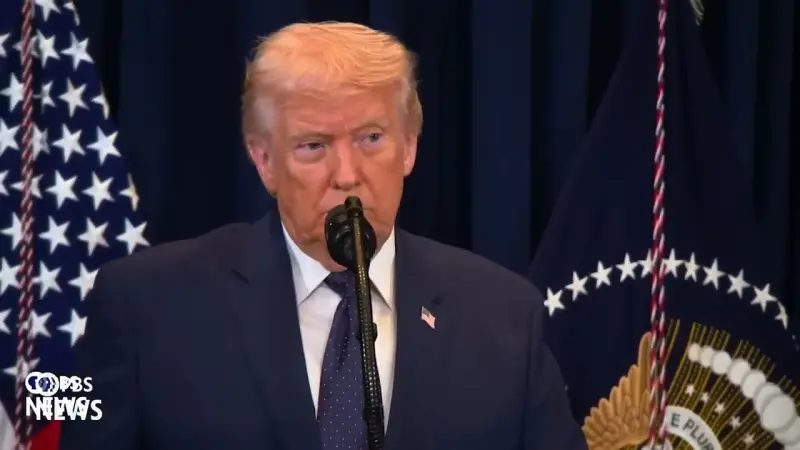
WASHINGTON — President Donald Trump asserted during a White House press briefing Tuesday that Iran has acquired Tomahawk cruise missiles, a claim that immediately prompted scrutiny from defense analysts, intelligence officials, and international arms control experts who are now actively fact-checking the potentially destabilizing assertion.
The President's declaration, made amidst rising tensions in the Persian Gulf region, suggested a significant escalation in Iran's military capabilities, implying Tehran has either secretly developed or procured advanced weaponry typically associated with major global powers. This statement quickly became a focal point for national security discussions, raising questions about intelligence assessments.
Independent verification efforts commenced swiftly across various platforms and institutions. Analysts at the Pentagon and within the intelligence community, speaking on background, indicated no corroborating evidence to support the President's specific claim regarding Tomahawk missiles.
A Tomahawk cruise missile, primarily developed and produced by the United States, is a long-range, all-weather, jet-powered, subsonic cruise missile capable of delivering conventional warheads with precision. Its advanced guidance systems and extended reach make it a formidable component of any modern naval or air force arsenal, far exceeding Iran's publicly acknowledged cruise missile capabilities.
Iran has, over decades, developed a substantial indigenous missile program, focusing primarily on ballistic missiles and various short-to-medium range anti-ship and land-attack cruise missiles. These include its Qader and Soumar series, which bear some conceptual similarities to older Western or Russian designs, but are distinct from the highly sophisticated Tomahawk.
Numerous public and classified reports from international bodies like the International Atomic Energy Agency, along with Western intelligence assessments, have consistently detailed Iran's missile inventory without ever mentioning the presence of Tomahawk missiles. The absence of any procurement or development efforts for such a complex system has been a consistent finding.
Dr. Sarah Chen, a senior fellow specializing in missile proliferation at the Center for Strategic and International Studies, commented on the assertion. "While Iran continually seeks to enhance its defense posture, the acquisition or independent development of Tomahawk-equivalent missiles would be a monumental technological leap requiring years of effort and resources that would be extremely difficult to conceal from global surveillance," Dr. Chen stated.
Such a claim, if unverified, carries substantial geopolitical weight. It could be interpreted as a precursor to heightened defensive measures by the United States and its allies in the region, or as an attempt to justify more stringent sanctions or military posturing against Tehran.
This is not the first instance a US president has made claims about foreign military assets that required extensive clarification. The imperative for accurate, verifiable information remains paramount, particularly when discussing sensitive issues of international security and proliferation.
Calls for the White House to provide specific intelligence to substantiate the President's assertion have grown from Capitol Hill. Democratic and some Republican lawmakers emphasized the need for transparency, citing the potential for miscalculation in a volatile region.
A Pentagon spokesperson, when asked directly about the President's statement, deferred to the intelligence community for specific details, reiterating the department's commitment to monitoring all threats to US interests and regional stability. This indirect response did little to quell the skepticism.
The assertion could also complicate diplomatic efforts. With various international parties seeking de-escalation in the Middle East, an unsubstantiated claim of advanced missile proliferation could inadvertently sabotage potential pathways for dialogue and conflict resolution.
In an era rife with disinformation, the role of rigorous fact-checking is more critical than ever, especially when statements emanate from the highest levels of government. Public confidence in official pronouncements hinges on their factual basis.
President Trump has a history of making strong declarations concerning Iran's military capabilities and intentions. While his administration consistently frames Iran as a primary threat to regional security, the specific claim about Tomahawk missiles represents a new and distinct allegation.
As the international community awaits further details, the onus remains on the US administration to either present compelling evidence or clarify the basis of President Trump's surprising statement. The repercussions of such a claim, regardless of its veracity, are already rippling through diplomatic and defense circles globally.