Gabriella
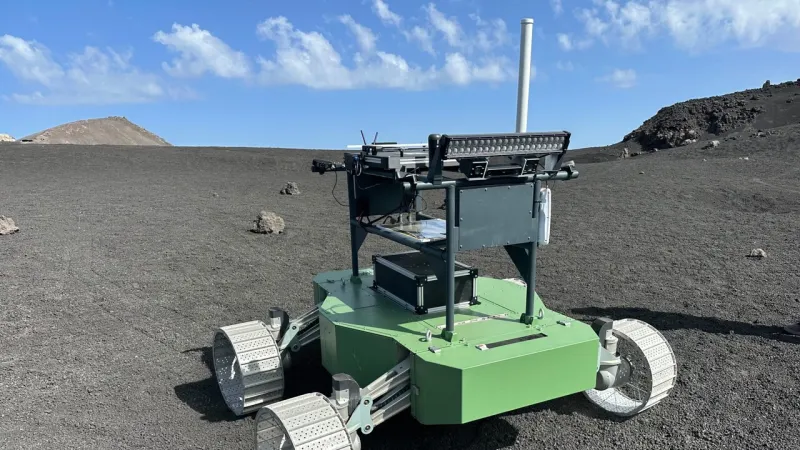
Mount Etna, Sicily, Italy — Engineers from the Italian Space Agency (ASI) are currently conducting advanced field tests for a new generation lunar exploration robot on the rugged, volcanic terrain of Mount Etna. The ambitious trials aim to simulate the harsh conditions of the Moon's surface, ensuring the robot's operational readiness and resilience for forthcoming missions to Earth's celestial neighbor.
The choice of Europe's most active volcano as a testing ground is deliberate. Etna's desolate, rocky landscape, characterized by lava flows, craters, and steep inclines, offers an unparalleled natural analogue to the lunar environment. This unique geological setting provides a crucial proving ground for the robot's navigation systems, locomotion, and scientific instrumentation before its eventual deployment to the Moon.
Officials from the Italian Space Agency emphasized the strategic importance of these trials. A spokesperson for ASI stated, "It is one of the best places to experiment with it," highlighting the volcano's suitability for replicating extraterrestrial conditions. This sentiment underscores Italy's commitment to advancing its capabilities in robotic space exploration.
While specific details about the robot's name or a precise mission timeline remain under wraps, the testing program suggests a significant leap in Italian technological prowess. The robot is designed to perform a range of tasks, including geological sampling, terrain mapping, and data collection, all vital for understanding lunar formation and potential resource utilization.
Lunar exploration presents formidable challenges, from extreme temperature fluctuations and radiation exposure to the abrasive regolith and complex topography. The rigorous testing on Etna helps engineers identify potential weaknesses and refine the robot's design to withstand these punishing extraterrestrial factors, ensuring mission success.
Italy has a distinguished history in space science and technology, contributing significantly to international missions, including those by the European Space Agency (ESA) and NASA. These tests on Etna position Italy as a key player in the renewed global race for lunar dominance, extending beyond traditional satellite development to advanced robotic exploration.
The development of this Italian lunar robot incorporates cutting-edge advancements in artificial intelligence, autonomous navigation, and specialized materials. Its sophisticated sensor suite allows it to perceive and interact with its environment, making real-time decisions that are critical for uncrewed missions operating millions of miles from Earth.
Comparison to other sites and methods reveals the unique value of Etna. While simulations in controlled laboratory environments are standard, real-world field tests like those on Etna offer an invaluable layer of complexity and authenticity. Such terrestrial analogues provide engineers with practical experience in dealing with unexpected terrain features and environmental variables that virtual models cannot fully replicate.
The data gathered by such advanced robots will contribute immensely to planetary science, offering new insights into the Moon's geological history, the presence of water ice, and its potential as a base for future human expeditions. Each successful test moves humanity closer to establishing a sustained presence beyond Earth.
The successful conclusion of these trials on Mount Etna will mark a critical milestone for Italy's space program. It not only validates the robot's design and functionality but also paves the way for its integration into forthcoming international lunar missions, underscoring Italy's growing influence in the burgeoning field of space exploration.
The demanding slopes of Etna are not merely a testing ground; they are a crucible, forging the capabilities of machines that will venture where humans cannot easily tread, pushing the boundaries of scientific discovery and our understanding of the cosmos.