 Debby Wijaya
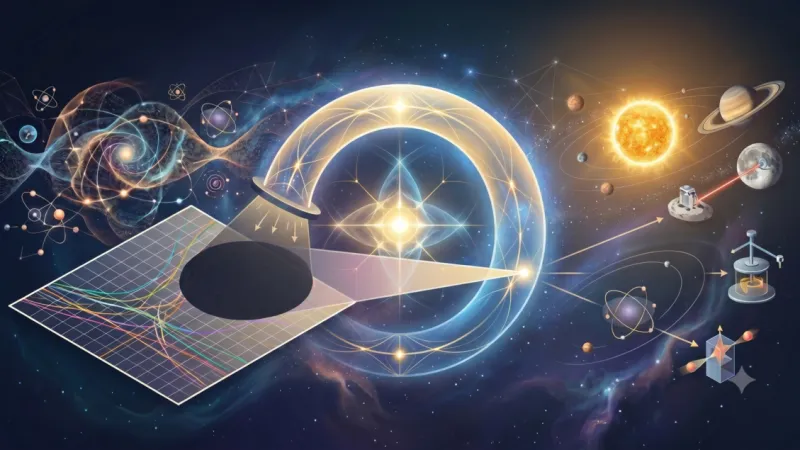
The global scientific community is narrowing its focus in the protracted search for the elusive fifth fundamental force of nature. Recent advancements in the field of quantum gravity have played a pivotal role, allowing researchers to discard several previously considered characteristics of this hypothetical interaction, thereby refining the experimental and theoretical landscape.
For decades, the Standard Model of particle physics has served as humanitys most successful description of the universe, outlining four fundamental forces: gravity, electromagnetism, and the strong and weak nuclear forces. These forces govern all known interactions between particles, from the macroscopic realm of planetary motion to the microscopic intricacies of atomic nuclei.
However, persistent anomalies in astrophysical observations and certain particle physics experiments have fueled the hypothesis that an unknown fifth force of nature might exist. Phenomena such as dark matter and dark energy, which constitute the vast majority of the universe's mass and energy, remain unexplained by the Standard Model, prompting physicists to explore new fundamental interactions.
Quantum gravity represents the theoretical quest to reconcile Albert Einsteins general relativity, which describes gravity at cosmic scales, with quantum mechanics, which governs the behavior of matter and energy at the atomic and subatomic levels. This ambitious endeavor seeks a unified framework that describes all forces and particles coherently.
The application of quantum gravity principles has enabled scientists to establish constraints on the potential properties of a fifth force. By examining how such a force would interact with spacetime at extreme energy densities or microscopic distances, theoretical models can rule out characteristics that contradict current quantum gravitational understanding or experimental bounds.
Specifically, researchers have leveraged sophisticated calculations to eliminate certain hypothetical force-carrying particles or interaction ranges that would otherwise lead to inconsistencies within a quantum gravity framework. This intellectual rigor ensures that the search progresses along more plausible scientific pathways, minimizing speculative detours.
The significance of this narrowed field cannot be overstated. By pruning the vast tree of theoretical possibilities, scientists can concentrate resources and ingenuity on designing experiments and developing further theoretical models that target the more viable characteristics of a fifth force of nature. This focused approach accelerates the pace of discovery.
Numerous experiments worldwide continue their dedicated hunt for this enigmatic interaction. Particle accelerators, precision atomic measurements, and astrophysical observations of cosmic phenomena are all contributing crucial data, seeking any subtle deviation from the predictions of the Standard Model that could signal a new force.
The potential confirmation of a fifth force would represent a paradigm shift in physics, necessitating a revision of the Standard Model and fundamentally altering our understanding of the cosmos. It could unlock new insights into dark matter, dark energy, and the very fabric of reality.
This ongoing scientific journey underscores the iterative nature of discovery: proposing hypotheses, rigorously testing them against theoretical frameworks and empirical data, and continually refining our understanding. Quantum gravity, while still incomplete, demonstrably serves as a potent tool in this profound quest for universal truths.