 Stefani Rindus
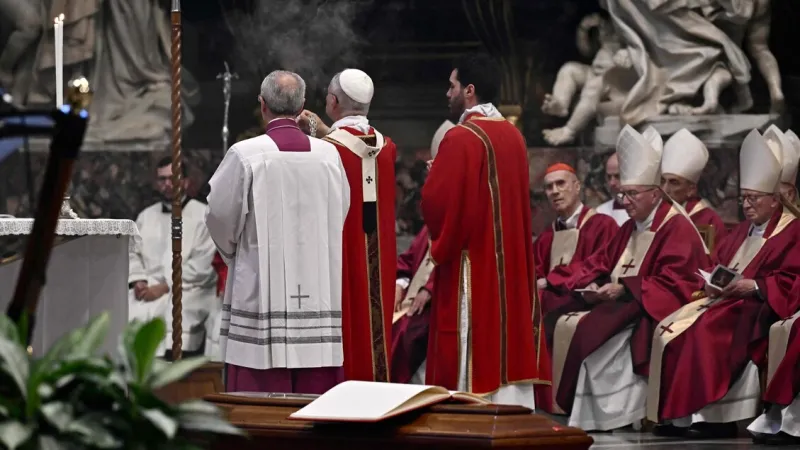
Vatican City – Pope Francis today presided over the solemn funeral rites for Cardinal Camillo Ruini in St. Peter's Basilica, an event drawing a significant confluence of high-ranking cardinals and prominent Italian politicians. The ceremony served not only as a farewell to a towering figure of the Italian Church but also as a profound reflection on his enduring theological and pastoral legacy, particularly his staunch opposition to moral relativism.
Cardinal Ruini, who passed away recently, was a highly influential figure, having served as President of the Italian Episcopal Conference for sixteen years and as Vicar General for the Diocese of Rome. His intellectual rigor and deep spiritual conviction shaped a generation of Catholic thought and policy in Italy, extending his influence far beyond ecclesiastical circles.
Among those present to pay their respects were an array of notable figures, underscoring Ruini's broad impact. Cardinals such as Matteo Zuppi, the current President of the Italian Episcopal Conference, stood alongside political leaders including Undersecretary of State Alfredo Mantovano, Family Minister Eugenia Roccella, and former Prime Minister Romano Prodi, reflecting the cardinal's significant role at the intersection of faith and public life.
The homily delivered during the service emphasized Cardinal Ruini's unwavering commitment to the foundational truths of Christian doctrine and his eloquent, persistent critique of moral relativism. This philosophical current, which suggests that moral truths are not absolute but relative to individuals or cultures, was a central concern throughout his intellectual and pastoral career.
For Cardinal Ruini, the challenge of relativism represented a significant threat to the coherence of faith and the stability of society. He consistently argued that abandoning objective moral standards leads to a societal fragmentation, undermining the very basis for justice and human dignity.
Pope Francis, while known for his emphasis on mercy and pastoral outreach, implicitly acknowledged the continued relevance of Ruini's concerns. The Pope's presence at the exequies highlighted a recognition of the cardinal's immense contribution to the Church's intellectual heritage and his persistent efforts to uphold the clarity of Catholic teaching in a complex world.
Ruini's long tenure at the helm of the Italian Episcopal Conference saw him navigate numerous social and political debates, consistently advocating for Catholic principles on issues ranging from bioethics to family values. His leadership provided a clear moral compass during times of rapid cultural change.
His vision was not merely theoretical; it translated into concrete actions and pastoral initiatives aimed at strengthening Catholic identity and engagement in public discourse. He believed deeply in the Church's role as a prophetic voice in society, challenging prevailing ideologies that he perceived as detrimental to human flourishing.
The notion of vision against relativism remains a potent theme in contemporary religious and political discourse. Debates surrounding foundational values, freedom of expression, and cultural identity frequently touch upon the very concerns Cardinal Ruini articulated decades ago. For instance, discussions on societal norms and the boundaries of tolerance often echo the core tension between absolute truths and fluid interpretations. This is particularly evident in debates across Europe regarding cultural assimilation and the preservation of traditional societal structures, which can sometimes be seen in discussions surrounding topics such as those highlighted in articles like Seyran Ateş Blasts German TV for Normalizing Sharia Fashion.
Critics of relativism, like Ruini, contend that it ultimately erodes shared ethical frameworks, making constructive dialogue and social cohesion increasingly difficult. He championed a return to universal moral principles rooted in natural law and divine revelation.
As Vicar General of Rome, Cardinal Ruini was also instrumental in guiding the spiritual life of the Eternal City, overseeing countless pastoral programs and initiatives. His administrative acumen complemented his theological depth, making him a formidable leader.
The solemnity of the funeral service in St. Peter's, replete with traditional Catholic liturgy, served as a powerful testament to the Church's reverence for its intellectual giants. The confluence of spiritual and temporal leaders present underscored the enduring influence of men like Cardinal Ruini, whose legacies transcend their lifetimes.
The passing of Cardinal Ruini marks the end of an era for many within the Italian Church. Yet, the principles he so vigorously defended, particularly his robust argument for objective truth against the tides of relativism, are clearly considered by many to be more relevant than ever in the ongoing global dialogue about faith, ethics, and society.
His memory, and the intellectual framework he championed, will undoubtedly continue to inspire theological reflection and pastoral action, ensuring his vision against relativism remains a touchstone for future generations navigating complex moral landscapes.