Angel Doris
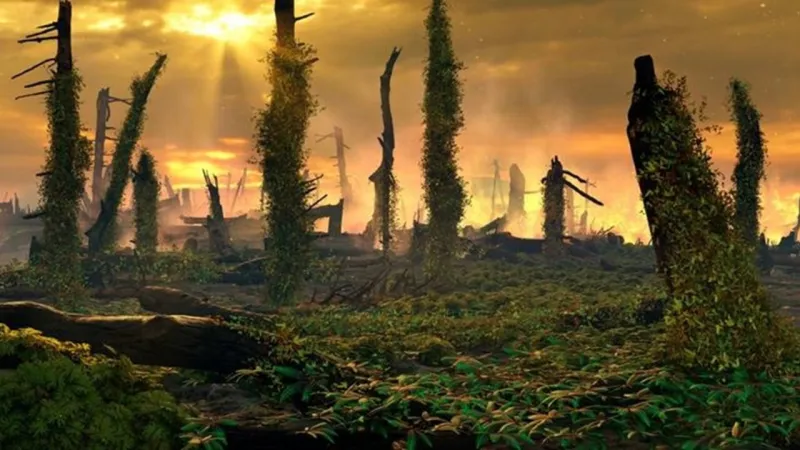
Europe - A groundbreaking study has unveiled a grim chapter in ancient Earth's history, revealing that Europe during the Triassic period was a veritable inferno, experiencing wildfires that raged for thousands of years. This prolonged devastation, occurring approximately 252 to 201 million years ago, resulted from a calamitous synergy of active volcanoes, extreme climatic warming, and vast fern prairies that provided abundant fuel.
The sheer scale of these ancient conflagrations challenges conventional understanding of prehistoric environmental disasters. Unlike seasonal forest fires common today, these blazes persisted for epochs, fundamentally reshaping continental ecosystems and atmospheric composition across a nascent European landmass.
Scientists attribute the exceptional duration and intensity of these fires to the geological and climatic conditions prevalent during the Triassic. This era, immediately following the Permian-Triassic extinction event, saw the supercontinent Pangea beginning its slow drift, accompanied by immense tectonic and volcanic activity.
Central to this fiery narrative was rampant volcanism. Massive eruptions released prodigious quantities of ash and greenhouse gases into the atmosphere. The original data indicates widespread active volcanoes, and scientific consensus points to large igneous provinces, such as the Central Atlantic Magmatic Province (CAMP), which are known to have erupted extensively during the Late Triassic.
These eruptions not only blanketed landscapes with ignitable debris but also injected vast amounts of carbon dioxide into the atmosphere. This atmospheric CO2 acted as a powerful greenhouse gas, trapping heat and driving a period of extreme global warming, far surpassing even the most dire modern climate projections.
Under such arid and superheated conditions, the widespread fern prairies became highly combustible. These resilient plants, thriving in the aftermath of the Permian extinction, formed expansive, dense biomass across the low-lying plains of Triassic Europe, creating an inexhaustible fuel source for ignited landscapes.
The ignition sources for these enduring fires were likely manifold. Increased lightning strikes due to altered atmospheric conditions, combined with the heat from volcanic activity itself, could have easily sparked these colossal blazes, which then sustained themselves in the highly flammable, dry environment.
Evidence for these ancient infernos comes from the geological record. Paleontologists and geologists have discovered widespread layers of fossilized charcoal within sedimentary rock formations across various European locales corresponding to the Triassic period. These charcoal deposits provide irrefutable proof of extensive combustion events.
The consistent presence of these charcoal horizons across vast geographical areas indicates a synchronized and long-lasting pattern of widespread burning rather than isolated incidents. Isotopic analysis of these layers further corroborates the extreme atmospheric conditions of the time.
The prolonged wildfires had profound ecological consequences. They would have repeatedly reset successional patterns, favoring fire-adapted species and potentially hindering the recovery and diversification of complex forest ecosystems. This environmental pressure likely influenced the evolutionary trajectories of early dinosaurs and other Triassic fauna.
Understanding these ancient fire regimes offers crucial insights into Earth's inherent vulnerability to rapid climate shifts and widespread environmental breakdown. The Triassic inferno serves as a potent reminder of the potential for cascading ecological disasters triggered by combined geological and atmospheric forces.
Further research will undoubtedly explore the precise mechanisms of fire spread, the feedback loops between volcanism and climate, and the long-term biological impacts on the emerging Triassic biodiversity. These investigations continue to deepen our appreciation for the dynamic and often tumultuous history of our planet.