 Dorry Archiles
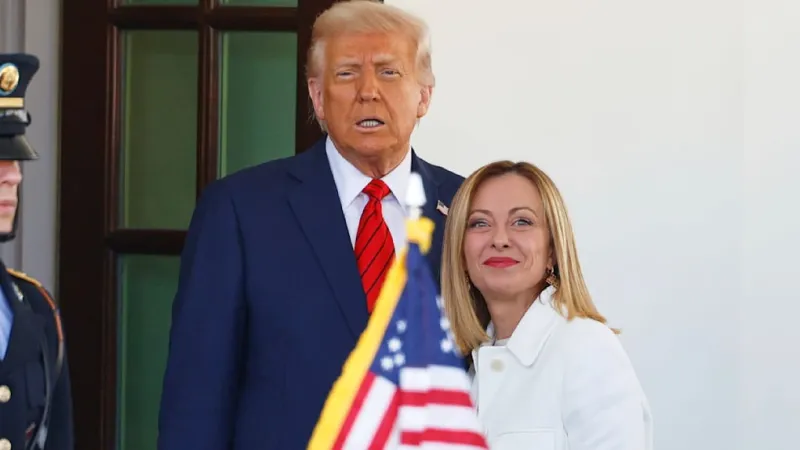
WASHINGTON – President Donald Trump publicly rebuffed Italian Prime Minister Giorgia Meloni following the recent G-7 summit, asserting that she had "repeatedly begged" for photo opportunities and now sought a renewed friendship that he was unwilling to grant. The surprising declaration, disseminated from the White House, signals a notable diplomatic chill between the two leaders and their respective nations.
Trump's pointed remarks, delivered after the high-profile international gathering, characterized Meloni's actions as a persistent effort to capture his attention. According to reports detailing his statement, the President indicated that despite her alleged overtures for a closer bond, he was no longer interested in fostering such a relationship.
This public declaration marks a significant turn in the often-complex dynamics of global leadership, particularly among G-7 members. Such candid and direct disavowals are rare in the carefully choreographed world of international diplomacy, suggesting a deeper undercurrent of disagreement or personal friction.
The President's statement did not explicitly detail the specific moments or occasions where Meloni allegedly sought these photo opportunities. However, the timing suggests that any perceived lobbying for proximity took place within the confines of the recent G-7 proceedings, a forum typically reserved for high-level policy discussions and strategic alignments.
Observers familiar with Trump's approach to foreign policy note his transactional nature and willingness to call out perceived slights or misalignments publicly. This latest incident appears consistent with his long-standing strategy of using direct communication to convey his stance on international relationships.
While the primary reason cited by President Trump was Meloni's alleged pursuit of photo ops, underlying policy differences may also contribute to the strained relationship. Earlier reports, such as those detailed in the article Trump Rebuffs Meloni: Italy's Iran Stance, Base Access Cited, indicated that Italy's position on Iran and its stance on US military base access had previously been points of contention.
Italy, a crucial NATO ally, has navigated a delicate balance in its foreign policy, particularly concerning its engagement with the Middle East and its relationship with the United States. Any perceived divergence from US strategic interests, especially on critical issues like Iran, could trigger a strong reaction from the White House.
The G-7 summit itself is designed to foster cooperation and consensus among leading industrial nations. A public rebuke of one member state's leader by another, particularly the President of the United States, risks undermining the spirit of unity and collective action that the forum aims to project.
Meloni's government has been a key player in European politics, often aligning with conservative movements across the continent. Her efforts to forge stronger ties with the US have been a consistent theme of her tenure, making Trump's latest statement particularly impactful.
The implications of this diplomatic fallout extend beyond mere personal friction. A soured relationship between the US and Italy could affect bilateral agreements, trade discussions, and cooperation on global security challenges, from counterterrorism efforts to economic stability in the Eurozone.
Historically, President Trump has shown a preference for leaders who demonstrate strong personal loyalty and align closely with his "America First" agenda. Deviations from this alignment, whether perceived or actual, have often resulted in public expressions of disapproval.
The use of the phrase "begged for photos" by President Trump is particularly striking. It conveys a strong sense of dismissal and belittlement, potentially designed to underscore a perceived power imbalance or to highlight a lack of genuine diplomatic engagement on Meloni's part.
This incident also raises questions about the future of transatlantic relations and the resilience of alliances in the face of personalized diplomacy. European leaders will undoubtedly be watching closely to see how this dispute evolves and what it signifies for their own interactions with the current US administration.
For Meloni, the public snub could pose domestic challenges, potentially affecting her credibility as a strong international voice and her ability to navigate complex geopolitical landscapes. Her government will likely need to formulate a careful response to mitigate any negative perceptions.
The White House has not yet issued further clarification on the President's statement, leaving room for speculation about the full scope of the disagreements. The brevity and directness of the initial remarks amplify their diplomatic weight.
Beyond immediate political concerns, this episode underscores the evolving nature of international statecraft in the 21st century, where leaders' personal expressions and social media engagements often carry as much weight as formal diplomatic communiques.
The coming weeks will be critical in observing any official responses from Rome or further commentary from Washington. The incident casts a shadow over the otherwise positive narratives typically emerging from high-level summits, pointing to deeper rifts that may define bilateral relationships in the present political climate.
Ultimately, President Trump's firm rejection of renewed friendship with Prime Minister Meloni represents a significant development in US-Italy relations, fueled by what he perceives as a history of one-sided overtures and potentially deeper policy disagreements. The ramifications of this public diplomatic chill are likely to resonate through both European and global political discourse.