 Angela Stefani
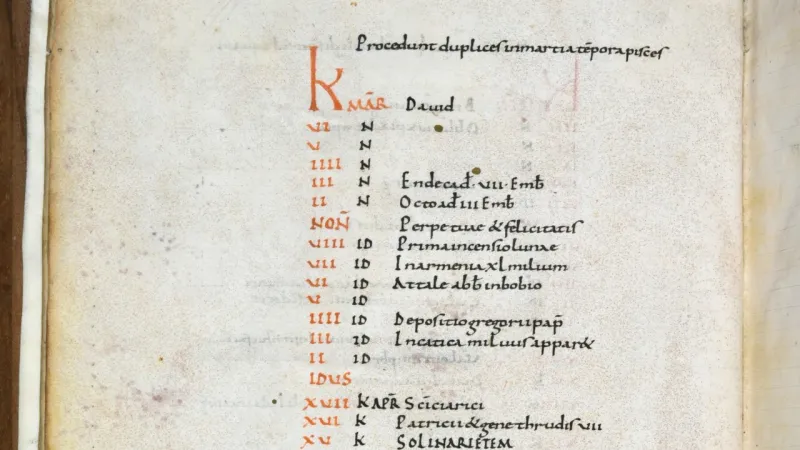
A remarkable Carolingian calendar, dating back to 813 AD and recently uncovered in Florence, Italy, has stunned historians and astronomers by demonstrating a sophisticated understanding of the solar year that predates the renowned Gregorian Reform by nearly seven centuries. This ancient document reveals that scholars of the early medieval period were already adjusting the solar year by approximately three days, offering unprecedented insight into intellectual advancements of the era.
The manuscript, of Carolingian age, provides compelling evidence that the inherent inaccuracies of the Julian calendar were recognized and addressed by some European scholars far earlier than previously assumed. The Julian calendar, implemented by Julius Caesar in 45 BC, famously miscalculated the length of a year by roughly 11 minutes, leading to a drift of about three days every four centuries.
This newly discovered Florentine manuscript, dated precisely to 813 AD, directly addresses this accumulating error. Its sophisticated astronomical computations indicate a conscious effort to realign the calendar with the true solar year, a feat that challenges conventional narratives about the pace of scientific progress during the so-called Dark Ages.
Historians have long credited the 16th-century Gregorian Reform, enacted by Pope Gregory XIII in 1582, as the pivotal moment for rectifying the Julian calendar's drift. That reform famously omitted ten days to catch up with the equinoxes and introduced the leap year rule we largely follow today. The 813 AD Carolingian calendar discovery suggests a lineage of astronomical observation and correction that extends much further back.
Experts analyzing the Carolingian calendar believe its creators possessed a profound grasp of celestial mechanics and mathematical principles. While the exact methodology employed by these early medieval astronomers remains a subject of intense study, the outcome—a three-day correction over an unspecified period—is undeniable.
The Carolingian era, particularly under Emperor Charlemagne, experienced a significant cultural and intellectual renaissance. This period saw a resurgence in learning, the standardization of Latin, and the copying of ancient texts, fostering an environment where such advanced calculations for a solar year correction could conceivably emerge and be preserved within scholarly circles.
This discovery compels a re-evaluation of the scientific capabilities present in medieval Europe. Rather than a static period awaiting later enlightenment, this Florentine manuscript highlights pockets of profound intellectual curiosity and rigorous scientific inquiry, particularly in the realm of calendrical science.
The meticulous craftsmanship evident in the calendar, characteristic of Carolingian scriptoria, further underscores the importance placed on accurate timekeeping and astronomical observation during that period. Such a detailed document would have required significant resources and collaborative scholarship to produce.
While the wider adoption of such a correction across Europe did not occur until the Gregorian Reform, the existence of this 813 AD calendar proves that the foundational knowledge and the drive to improve calendrical accuracy were present centuries prior. It speaks to the ingenuity of early medieval scholars who quietly pursued scientific truth.
Future research will likely focus on comparing this Florentine Carolingian calendar with other surviving manuscripts of the era to determine if similar corrections were known or implemented elsewhere. The long-term implications for understanding the transmission of scientific knowledge through medieval Europe are vast.
This significant finding in Florence not only enriches our understanding of medieval history and science but also serves as a powerful reminder that intellectual breakthroughs can emerge in unexpected times and places, far removed from the spotlight of mainstream historical narratives. It is a testament to the continuous human quest for precision and understanding of the natural world.
The Carolingian calendar manuscript now provides a crucial new piece in the intricate puzzle of historical astronomy, challenging long-held assumptions and sparking new avenues of inquiry into how our ancestors perceived and organized time. It firmly establishes an earlier benchmark for calendrical refinement.