 Angela Stefani
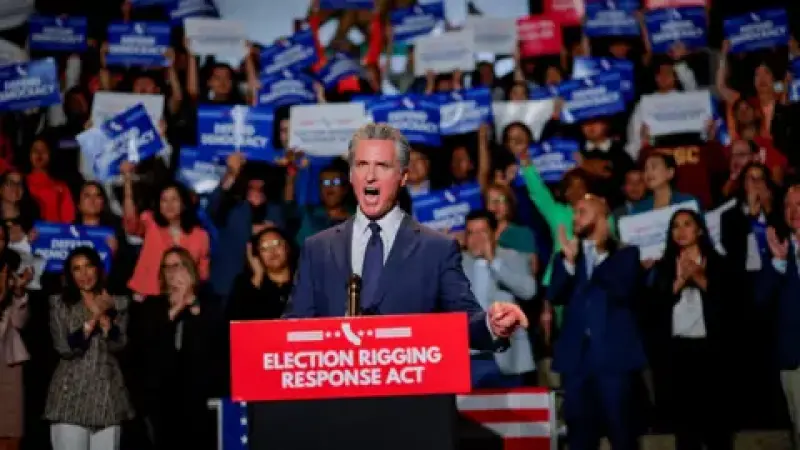
SACRAMENTO — Governor Gavin Newsom is confronting mounting pressure to strategically intervene in California's increasingly chaotic gubernatorial race, a contest currently lacking a clear Democratic frontrunner and complicated by a surging Republican challenge. This volatile dynamic, unfolding months before the November 2026 general election, threatens to fracture party unity and could reshape the state's political landscape.
The absence of a dominant candidate among Democrats has created a crowded field, with multiple hopefuls vying for the party's nomination. This splintering of the progressive vote has prevented any single contender from consolidating support, leaving the party vulnerable against a unified opposition.
Sources within the Democratic Party, speaking on background due to the sensitivity of the internal discussions, indicate that major donors and veteran strategists are increasingly vocal in their demands for Newsom to take a decisive stand. They argue that his continued neutrality risks ceding critical ground to Republicans.
A well-funded and disciplined Republican challenger has capitalized on the Democratic disarray, steadily gaining momentum in recent polls. This unexpected strength from the opposition has heightened anxieties among Democrats, who traditionally enjoy a significant advantage in California statewide elections.
Newsom, who has largely remained above the fray, now faces a pivotal moment. His decision to intervene, or to maintain his distance, carries substantial implications not only for the governorship but also for his own political legacy and future aspirations.
The stakes are particularly high given the current national political climate under President Donald Trump. A loss of the California governorship would be a significant symbolic and practical blow to the Democratic Party, diminishing its influence in a critical blue state.
Intervention could take several forms, including a direct endorsement, substantial financial backing for a preferred candidate, or actively campaigning. Such a move would undoubtedly elevate one candidate while potentially marginalizing others, a delicate act with inherent risks.
However, the path of non-intervention is fraught with its own dangers. Without a clear signal from the party's most prominent figure, the primary race could devolve into a protracted and damaging internecine battle, leaving the eventual nominee weakened and financially depleted for the general election.
Historically, governors have often played a kingmaker role in their party's succession battles, but the current climate demands a careful calibration. A heavy-handed approach by Newsom could alienate a significant portion of the Democratic base, fostering resentment rather than unity.
Political analysts suggest that Newsom's delay in backing a candidate stems from a desire to avoid an early political commitment that might backfire, especially if his chosen candidate struggles. Yet, the current dynamics suggest that the cost of inaction may now outweigh the risks of engagement.
The outcome of California's governor race is not merely a state-level concern; it holds national implications. A strong Democratic showing is crucial for maintaining legislative balance and pushing back against policies emanating from President Donald Trump's administration.
The pressure on Gavin Newsom to intervene in this scrambled California governor race highlights the precarious nature of state-level politics, even in reliably Democratic strongholds. His forthcoming decision is eagerly anticipated by political observers across the nation.