 Chris Robert
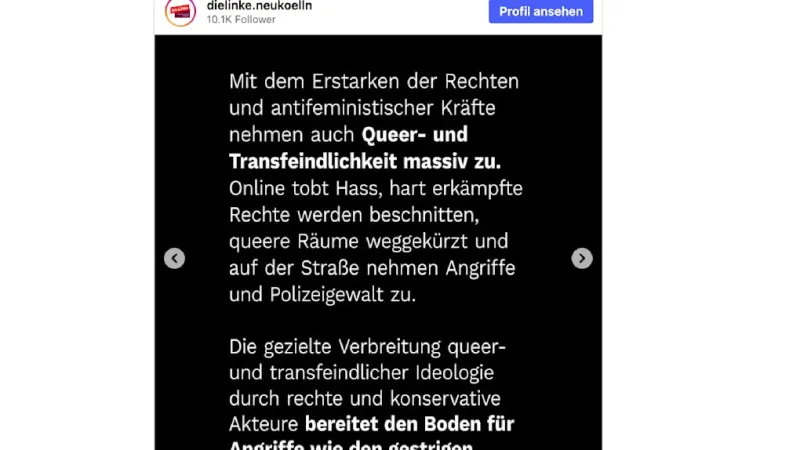
Berlin — A fatal attack during the citys annual CSD Pride celebration has ignited a fierce political debate within Germany, as Die Linke Neukölln faces sharp criticism for allegedly attributing blame to right-wing and anti-feminist forces while omitting any mention of the suspected Islamist motive of the assailant.
CDU politician Stefan Evers publicly condemned the Left party's stance, stating, "The denial of reality in dealing with political Islam is part of the problem of this left." His remarks underscore a growing chasm in political discourse regarding how best to confront extremist threats in Germany.
The incident, which tragically occurred during the Christopher Street Day parade, saw one participant killed and another seriously injured. While initial investigations pointed towards a perpetrator with Islamist leanings, the Left party's local chapter in Neukölln released a statement that conspicuously avoided this aspect.
Instead, Die Linke Neukölln focused its condemnation on what it termed broader societal issues, specifically blaming "right-wing and anti-feminist forces" for fostering an environment conducive to such violence. This selective attribution of cause has provoked a strong reaction across the political spectrum.
Evers did not mince words in his critique, suggesting that such an approach by a political party actively undermines efforts to understand and combat all forms of extremism. His statement highlights a persistent concern among conservative factions that some leftist groups are reluctant to acknowledge Islamist motivations for attacks, particularly when victims are part of the LGBTQ+ community.
The CSD attack has, in fact, sparked widespread discussion across the nation. Many public figures and security experts have called for a more honest and comprehensive assessment of threats posed by various extremist ideologies. For deeper context, readers can refer to how the Berlin CSD Attack Sparks Calls: End Islamist Threat Denial, reflecting a broader societal frustration.
This is not an isolated incident in Germany's recent history. The nation has grappled with various forms of extremism, including a deadly surge in vehicular attacks, some with confirmed Islamist links. The challenge lies in addressing these multifaceted threats without prejudice or ideological blind spots.
The criticism leveled at Die Linke Neukölln also resonates with the larger political discussion surrounding the attack. The event previously ignited a fierce debate on Islamism and public safety, with leaders from various parties demanding decisive action and transparent communication regarding the nature of the threat.
Political analysts suggest that the Left party's reluctance to acknowledge Islamist motives stems from a complex ideological framework. They often prioritize combating right-wing extremism and fascism, sometimes leading to an apparent downplaying of other, equally dangerous, forms of radicalism.
However, critics argue that this approach not only ignores critical facts but also leaves vulnerable communities, such as LGBTQ+ individuals, feeling unprotected and unacknowledged in the face of specific threats. Stefan Evers perspective reinforces the idea that an accurate threat assessment is paramount for effective counter-terrorism strategies.
The ongoing political fallout underscores the deep divisions within German society on how to tackle extremism effectively. The demand for an unbiased, fact-based approach to all forms of politically motivated violence, regardless of its origin, continues to grow louder among citizens and politicians alike.
As the country navigates these complex challenges, the debate over political Islam and its impact on public safety will undoubtedly remain a focal point of German domestic policy discussions for the foreseeable future. The call for political honesty and clarity in addressing all forms of radicalization has never been more urgent.