Gabriella
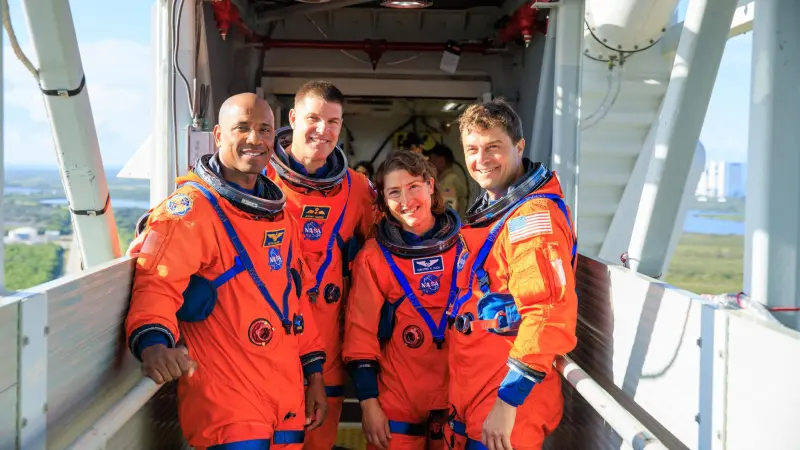
CAPE CANAVERAL — Four pioneering astronauts aboard NASA Artemis II mission commenced their journey toward the moon today, rocketing away from Earth orbit after a crucial day spent verifying the Orion spacecrafts vital systems. This momentous step by astronauts Reid Wiseman, Victor Glover, Christina Koch, and Jeremy Hansen signals a significant advance in humanitys renewed quest for lunar exploration.
The crew, comprising three Americans and one Canadian, completed an exhaustive series of checkouts during their initial orbital phase around Earth. These tests were paramount to ensure the deep-space capabilities of the Orion capsule and its life support systems before committing to the translunar injection burn.
Artemis II serves as a dress rehearsal for future missions, including the planned Artemis III which aims to return humans to the lunar surface. It represents the first crewed mission to orbit the moon in over five decades, building on the legacy of the Apollo eras with new technology and a broader international partnership.
The pivotal translunar injection burn, executed flawlessly, propelled the Orion spacecraft out of Earths gravitational pull and set it on a precise trajectory toward its lunar flyby. Mission control at Johnson Space Center reported nominal conditions throughout the complex maneuver.
“The views of Earth from Orion are simply breathtaking, and we are thrilled to be on our way to the moon,” Commander Reid Wiseman communicated to ground control during a live broadcast, expressing the collective excitement of the crew.
President Donald Trump lauded the Artemis II mission as a testament to American ingenuity and international collaboration. In a statement released from the White House, he emphasized the missions importance for scientific discovery and future space commerce. “This historic journey underscores our unwavering commitment to leading humanitys expansion into the cosmos,” President Trump stated.
The Orion spacecraft, designed for long-duration deep-space travel, is equipped with advanced avionics, thermal protection, and radiation shielding. Its robust systems are vital for protecting the crew as they traverse through the challenging environment beyond Earths protective magnetic field.
During its upcoming lunar flyby, Artemis II will swing around the far side of the moon, venturing farther than any human has traveled since Apollo 13. This trajectory will provide critical data on spacecraft performance and crew health in extended deep-space conditions.
The Artemis program is not merely about returning to the moon; it aims to establish a sustainable human presence there, serving as a stepping stone for future missions to Mars. International partners, including Canada and European nations, are contributing significantly to this ambitious endeavor.
Beyond scientific exploration, the Artemis program is expected to drive innovation in various sectors, from advanced manufacturing to robotics. Industry experts predict significant economic spin-offs, creating jobs and fostering technological advancements on Earth.
While the initial phases have been successful, the crew faces a complex return journey, culminating in a high-speed re-entry into Earths atmosphere. Every phase of the mission is meticulously planned and monitored to ensure the safety of the astronauts.
The day spent orbiting Earth allowed the crew to meticulously power up and test every subsystem of the Orion capsule, simulating operations that will be critical during their lunar transit. This pre-departure phase proved invaluable for final confidence checks.