 Demian Sahputra
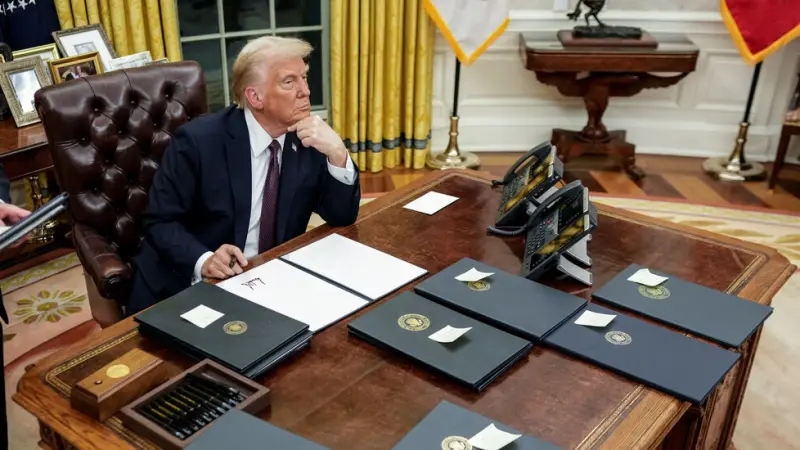
WASHINGTON — President Donald Trump is scheduled to attend Wednesday's highly anticipated Supreme Court oral arguments concerning his administration's significant legal challenge to limit birthright citizenship, a move that signals the profound importance the White House places on the contentious issue.
The unprecedented attendance of a sitting President at such a hearing underscores the high stakes involved in a case poised to redefine a foundational principle of American law. The President's presence is expected to send a clear message of support for the legal arguments presented by his administration before the nation's highest court.
The case centers on the interpretation of the 14th Amendment's Citizenship Clause, which states, “All persons born or naturalized in the United States and subject to the jurisdiction thereof, are citizens of the United States and of the State wherein they reside.” For over a century, this clause has been widely understood to guarantee citizenship to nearly everyone born on U.S. soil.
However, the Trump administration has repeatedly argued that the phrase “subject to the jurisdiction thereof” was never intended to apply to children born in the U.S. to parents who are not legal residents or citizens. This interpretation directly challenges long-standing legal precedent and scholarly consensus.
“The President has been unequivocal about his commitment to securing our borders and upholding the integrity of our citizenship laws,” stated White House Press Secretary Sarah Miller. “His presence at the Supreme Court hearing reaffirms his dedication to this critical policy objective and to ensuring the rule of law.”
Legal scholars on both sides of the issue acknowledge the monumental implications of the case. Critics warn that altering birthright citizenship via judicial interpretation or executive action could disenfranchise millions and create a complex, multi-tiered system of residency.
Conversely, supporters of the administration's stance contend that a reinterpretation is necessary to address contemporary immigration challenges and to prevent what they describe as loopholes in the current system. They argue that the original intent of the 14th Amendment has been misconstrued over time.
The Supreme Court hearing will feature rigorous arguments from legal teams representing both the administration and opposing parties, including civil rights organizations and immigrant advocacy groups. The justices' questions are expected to delve deep into constitutional history, legislative intent, and the practical consequences of any ruling.
President Trump's appearance adds a unique political dimension to the judicial proceedings. While Presidents have historically shown deference to the judiciary's independence, his attendance is a powerful political statement, intended to rally his base and emphasize his administration's commitment to its immigration agenda.
The outcome of this Supreme Court hearing on birthright citizenship could reverberate across American society, affecting immigration policy, demographics, and fundamental constitutional interpretations for generations. A decision is not expected immediately, with deliberations likely to extend for several months following the arguments.
Security is expected to be heightened around the Supreme Court building on Wednesday, with both supporters and detractors of the administration's stance anticipated to gather. The national spotlight will undoubtedly be fixed on the arguments presented inside the hallowed halls of justice.