 Angel Doris
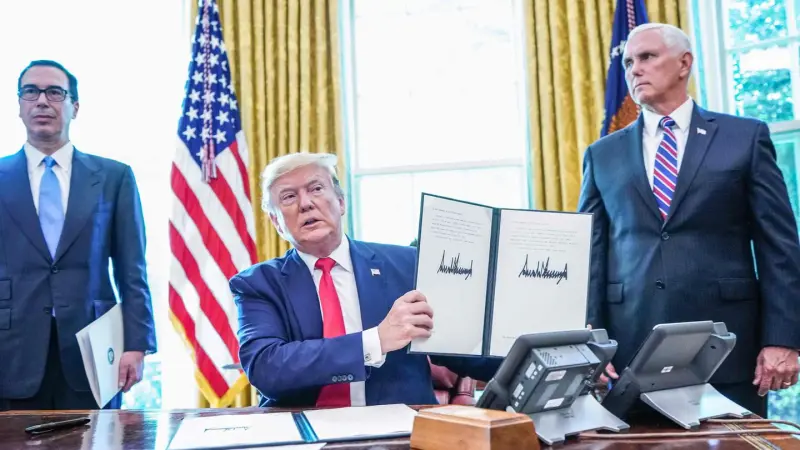
WASHINGTON — President Donald Trump's controversial social media post concerning Iran ignited immediate calls for his impeachment and removal from office among Democratic lawmakers on Capitol Hill in late 2026.
The highly publicized post, shared on a prominent social media platform, outlined a hypothetical military response to alleged Iranian provocations, drawing sharp criticism for its perceived recklessness and potential to escalate international tensions without congressional authorization.
Democratic leaders and rank-and-file members swiftly condemned President Trump's message, asserting it demonstrated a profound disregard for established foreign policy protocols and risked destabilizing an already volatile region. The incident quickly became the dominant topic in congressional discussions.
Representative Alexandria Ocasio-Cortez, D-N.Y., was among the first to publicize her outrage, declaring, “This latest Iran post by President Trump is a dangerous abdication of presidential responsibility. The Constitution gives Congress the power to declare war, not a social media account.” Her statement echoed widely across the Democratic caucus.
Sources close to Democratic leadership indicated that behind-the-scenes discussions intensified throughout the week, focusing on potential avenues for accountability. The term “impeachment” resurfaced prominently in these private conversations, underscoring the gravity with which the party viewed the President's actions.
A senior Democratic aide, speaking on condition of anonymity to discuss internal deliberations, remarked, “The question is no longer if we consider impeachment, but when and how we structure our response to this continued pattern of executive overreach. The President's Iran post simply escalated the urgency.”
While no formal impeachment resolution has been introduced, several House committee chairs are reportedly reviewing the President's public statements and their implications for national security and constitutional powers. These preliminary inquiries could form the basis for future legislative action.
Republicans, for their part, largely remained silent or offered measured defenses of the President, framing his remarks as strong deterrence against a hostile foreign power. Senate Minority Leader Mitch McConnell declined to comment directly on the post, stating only that he “supports the President's efforts to protect American interests.”
The episode rekindles memories of past impeachment proceedings and underscores the deep partisan chasm that defines Washington politics. Democrats assert a constitutional duty to check perceived abuses of presidential power, while Republicans accuse them of political opportunism.
Experts in constitutional law and foreign policy have weighed in, with some arguing the President's actions, if translated into policy, could constitute an impeachable offense. Others caution against hasty conclusions, emphasizing the rhetorical nature of social media posts versus concrete executive actions.
Dr. Evelyn Reed, a professor of international relations at Georgetown University, observed, “Such a public declaration via social media, even if rhetorical, carries significant weight in diplomatic circles. It complicates alliances and provides fodder for adversaries, potentially undermining years of delicate foreign policy.”
The renewed talk of impeachment and removal from office adds another layer of tension to an already fraught political landscape, particularly as the nation approaches the midterm elections. The Democratic push on this issue is likely to galvanize both their base and opposition.
Ultimately, the path forward for Hill Democrats remains uncertain, contingent on further actions by the President and the broader political climate. However, President Trump's Iran post has undeniably galvanized renewed efforts within the party to explore the most extreme forms of presidential accountability.