 Demian Sahputra
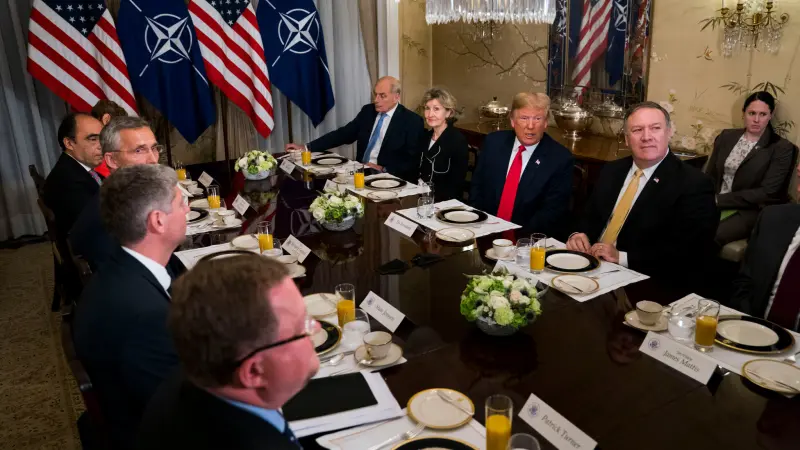
WASHINGTON — President Donald Trump announced today that a significant majority of NATO member nations have declined to participate in a proposed US-led maritime security coalition intended to safeguard the Strait of Hormuz, underscoring persistent transatlantic divergences regarding regional security strategies.
The President delivered the news from the Oval Office, stating that while the United States remains committed to ensuring freedom of navigation in the critical waterway, many of its traditional allies have expressed reservations about direct involvement in a Washington-spearheaded initiative.
This revelation comes after months of diplomatic outreach from the Trump administration, urging international partners to contribute assets and personnel to a multinational force. The coalition was conceived as a deterrent to what the US described as increasing threats to international shipping in the Persian Gulf.
The Strait of Hormuz, a narrow passage between the Persian Gulf and the Gulf of Oman, is one of the world's most vital maritime chokepoints. Approximately 20% of the world's petroleum liquids and a significant portion of its liquefied natural gas pass through its waters daily, making its security paramount to global energy markets.
European allies, including key NATO members such as Germany and France, have consistently advocated for de-escalation and diplomatic solutions over military confrontation in the region. Their stance often reflects a preference for independent European initiatives or broader UN-mandated operations rather than US-centric deployments.
The reluctance of these nations to join the US-led effort highlights a growing chasm in strategic priorities and approaches between Washington and its European counterparts. This divergence has been a recurring theme in transatlantic relations, particularly concerning regional security crises.
Analysts suggest that allies are wary of being drawn into a potential conflict that could disrupt delicate regional balances or escalate tensions further. Many European capitals prefer not to be perceived as taking sides in complex regional rivalries.
President Trump reiterated the United States determination to protect its interests and global shipping lanes, even without widespread allied participation in this specific venture. The administration is reportedly exploring alternative strategies and partnerships to address security concerns in the strait.
The decision by most NATO members represents a significant diplomatic setback for the administration's push for a united front in the Gulf. It forces Washington to reconsider the scope and scale of its planned security operations in the vital waterway.
The implications of this rejection extend beyond the immediate security of the Hormuz Strait, potentially affecting future NATO cooperation on other international security challenges. It prompts questions about the alliance's collective will and its capacity for unified action.
Experts from regional security think tanks indicated that while the US possesses formidable naval capabilities to act independently, a multilateral approach is often preferred for legitimacy and burden-sharing. The absence of key allies complicates diplomatic messaging.
The US Navy's Fifth Fleet, based in Bahrain, maintains a strong presence in the region and has been at the forefront of monitoring maritime activity. However, a broader coalition was seen as crucial for expanding surveillance and escort capabilities.
Discussions among NATO defense ministers in Brussels last month reportedly touched upon the Hormuz proposal, where significant concerns were voiced about the operational mandate and potential for mission creep. These internal debates underscored the divisions now made public.
The rejection also reflects broader skepticism among some allies regarding the effectiveness of military solutions for complex geopolitical issues, particularly in a region as volatile as the Middle East. Diplomacy and economic pressure are often preferred tools.
Global financial markets, while not showing immediate panic, will likely monitor developments closely. Any perceived increase in risk to shipping through the Strait of Hormuz can have swift impacts on crude oil prices and global trade logistics.
The administration has not yet detailed its next steps, but sources close to the White House suggest continued bilateral discussions with willing partners and an enhanced US solo presence may be on the table.
This development marks another chapter in the evolving relationship between the United States and its NATO partners, challenging traditional assumptions of automatic alignment on security matters and highlighting the push for more independent foreign policy stances among European nations.
The overarching goal for Washington remains the unimpeded flow of commerce through the Hormuz Strait, a principle it asserts is crucial for global economic stability and energy security.
The path forward for securing the critical maritime chokepoint now appears more complex, necessitating a re-evaluation of strategies and a renewed diplomatic effort to bridge the transatlantic divide.