 Angel Doris
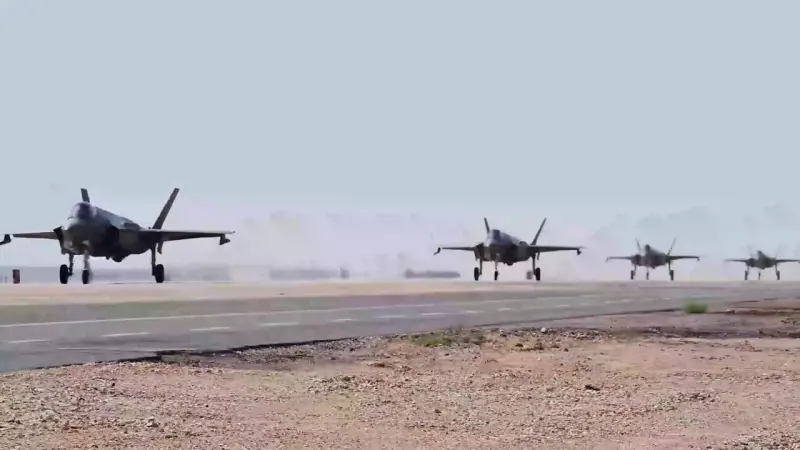
WASHINGTON — Iran's Islamic Revolutionary Guard Corps announced earlier today that it successfully shot down a second US F-35 Lightning II stealth fighter jet over its southwestern airspace, dramatically escalating already heightened tensions in the Persian Gulf region. The audacious claim, if confirmed, marks a significant military confrontation and follows a similar, disputed assertion by Tehran just months prior regarding another American F-35.
The Pentagon swiftly refuted Iran's declaration, dismissing it as "categorically false" and "disinformation aimed at destabilizing regional security." A senior defense official, speaking on condition of anonymity, stated there were no operational F-35 flights unaccounted for and no indications of any US aircraft being downed.
Iranian state media, citing an IRGC statement, reported that the advanced American jet was intercepted by a domestically produced surface-to-air missile system. Images purporting to show fragments of the wreckage were circulated on social media channels affiliated with the IRGC, though their authenticity could not be independently verified. Tehran did not provide immediate details on the pilot's status or the specific location of the alleged incident beyond "southwestern Iran."
This latest incident amplifies existing anxieties in a volatile region already grappling with proxy conflicts and continuous maritime disputes in the Strait of Hormuz, a critical global oil transit chokepoint. Both Washington and Tehran have significantly increased their military postures in and around the Gulf in recent years.
The development poses a fresh challenge for President Donald Trump's administration, which has maintained a firm stance against what it characterizes as Iranian aggression. White House Press Secretary Sarah Miller stated, "The United States remains committed to ensuring freedom of navigation and protecting our interests in the Middle East. We will not be intimidated by baseless propaganda."
The US Central Command (CENTCOM) maintains a robust presence in the Middle East, including advanced air assets like the F-35, deployed to deter threats and support regional allies. The F-35 Lightning II is a fifth-generation fighter known for its stealth capabilities and advanced sensor fusion.
Iran possesses a range of air defense systems, including Russian-made S-300 batteries and its own developed Bavar-373 system, which it claims can track and engage stealth aircraft. Tehran has a history of making ambitious military claims, some of which have been met with skepticism by international observers.
International bodies and allied nations have called for immediate de-escalation. United Nations Secretary-General António Guterres urged both sides to exercise maximum restraint and avoid any actions that could further destabilize the Middle East. European Union foreign policy chief Josep Borrell echoed these sentiments, stressing the need for diplomatic channels to remain open.
The news briefly sent jitters through global oil markets, with crude futures seeing a modest uptick before stabilizing as the Pentagon's denial provided some reassurance. Analysts noted that sustained uncertainty in the Gulf could significantly impact energy prices and global supply chains.
The alleged downing follows a pattern of provocative actions and counter-actions. In 2019, Iran shot down a US Global Hawk surveillance drone, claiming it had violated its airspace, a claim the US disputed. That incident brought the two nations to the brink of military conflict.
Military analysts suggest that while Iran's air defense capabilities have improved, successfully targeting a sophisticated stealth aircraft like the F-35 remains a formidable challenge. The lack of independent evidence supporting Iran's claim, combined with the Pentagon's unequivocal denial, casts significant doubt on its veracity for many experts.
Regardless of the truth, Iran's repeated claims serve to project strength internally and externally, aiming to challenge US dominance and potentially influence regional dynamics. The incident underscores the fragility of peace in the Gulf and the constant risk of miscalculation between major powers.